
The advancement of AI and layoffs raise the question: has the era of robot unemployment arrived?
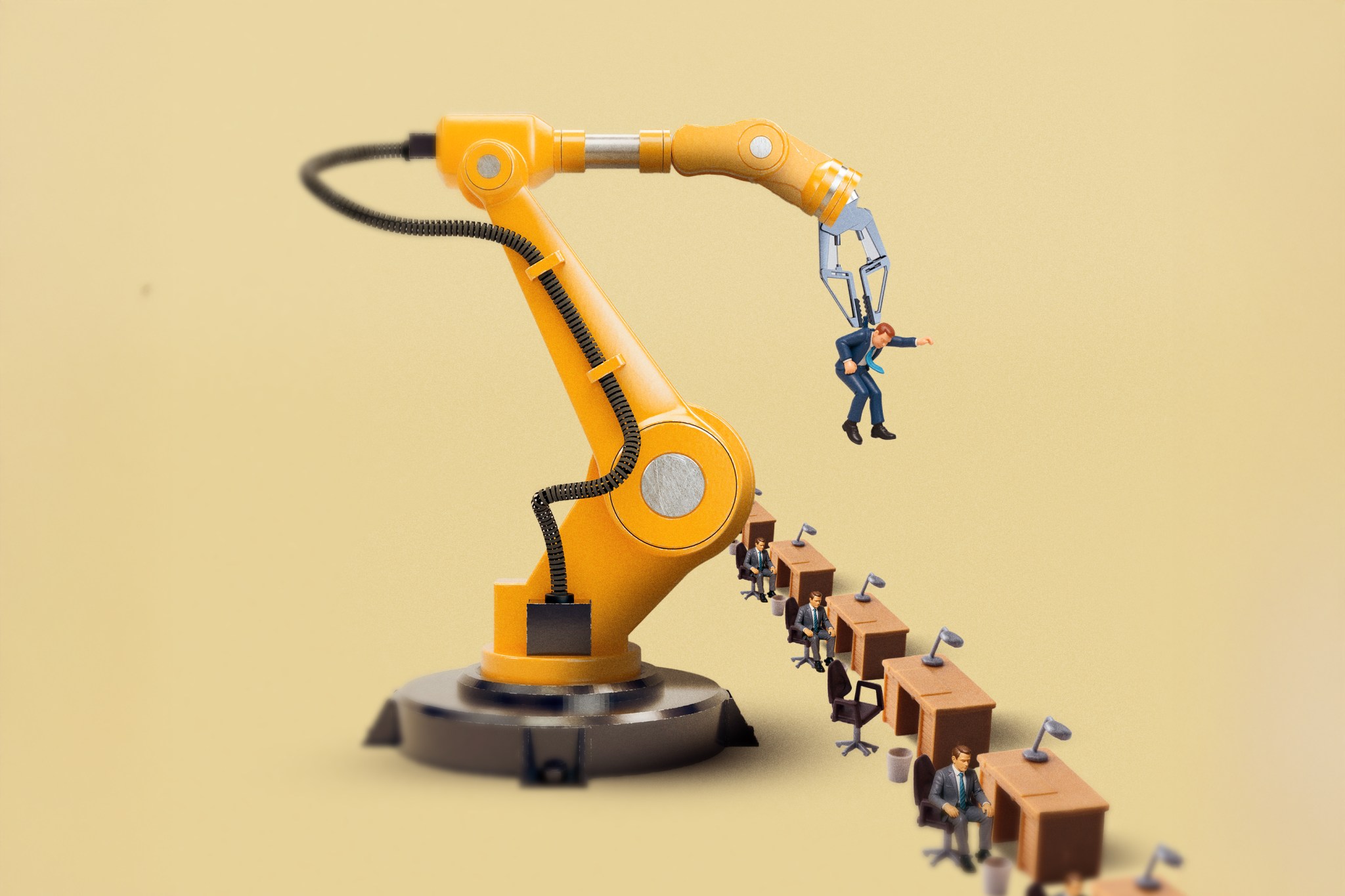
At a press event last year, Amazon Robotics chief technology officer Tye Brady told Fortune that the idea that there is a battle between robots and humans within Amazon’s warehouse network is a “myth.”
“We build our machines to augment human capabilities,” he said, sharing a vision of collaborative robots that work alongside humans rather than completely replacing them.
Also read: VIDEO: Chinese delivers “army of robots” that will work 24 hours a day
FREE TOOL
XP simulator
Find out in 1 minute how much your money can yield
About six months later, during an onstage interview at the Fortune Brainstorm AI conference in London, Brady told me about Amazon’s first robot “with a sense of touch.”
Called Vulcan, the robotic system can do much of the work done by human employees in two of the most common roles in Amazon warehouses — picking and putting away.
For now, the Vulcan system is only active in a few facilities and only handles items positioned on the top and bottom shelves of the company’s four-tier mobile units, while humans take care of the rest.
During this conversation, I questioned Brady about the human-robot dynamic. Amazon is not just any employer; is the second largest corporate employer in the US, and a company whose operational efficiencies many corporations would like to replicate.
So I asked him whether a hypothetical Amazon warehouse with 1,000 employees today could employ fewer than 1,000 workers in the coming years as the scope of Vulcan’s work grows, accompanied by complementary Amazon robotic systems. “No,” he insisted. Instead, such a hypothetical warehouse “could have a thousand (employees) or more.”
Less no? I insisted. “No less,” he said, describing a virtuous cycle where more robots lead to more orders fulfilled, which leads to more sales per employee in each warehouse. And more exceptional cases or errors require human intervention — in addition to human roles to repair and manage the robots themselves, which pay better than usual roles.
So what to make of a New York Times investigation into Amazon’s robotics ambitions, which cited internal plans to eventually automate about 75% of operations? The discovered memos suggested that the company’s fleet of robots could eliminate the need to hire around 600,000 employees in the future. (An Amazon spokesperson told the Times that the internal plans seen by the reporter reflected only the point of view of one team within the company.)
Of course, not creating additional jobs is different from cutting already hired warehouse workers — but there’s no denying that doing so would mean a major reorganization of the workforce.
The article quickly spread across the internet, with many social media posts criticizing the company’s apparent goal of reducing the need to create jobs for people.
Such fears are not unfounded; in fact, they are becoming the dominant anxiety of our age. Figuring out whether there will be enough human jobs in the future as AI and robotics proliferate is a conundrum that business leaders can no longer ignore.
Amazon warehouses, on average, employ fewer people per facility than at any time in the past 16 years, according to a Wall Street Journal analysis (although at least part of that is due to the company’s expansion into smaller facilities, which naturally require fewer employees).
Amid these concerns about the future of manual workers in Amazon warehouses, news has emerged of a large round of layoffs — this time among office workers. The company cut about 14,000 jobs, roughly 4% of its corporate strength.
The aim of the restructuring was to “reduce bureaucracy, remove layers and redirect resources to ensure we are investing in our biggest bets,” according to a company memo — but many took it as a sign that AI-related job losses have already begun.
This is not an unreasonable conclusion after CEO Andy Jassy wrote in June that as a result of greater use of AI internally, “we expect this to reduce our total corporate workforce as we gain efficiencies.”
Multiple publications have reported that a second significant round of layoffs will hit Amazon’s corporate muscle in January, following the peak holiday shopping period.
The big bets mentioned in the most recent layoff announcement include tens of billions of dollars that Amazon is investing annually in data centers and other infrastructure needed to meet the computing demands of AI, both for internal use and for corporate customers.
But it’s probably an oversimplification to attribute this round of layoffs — and staff reductions at companies like Microsoft, IBM, and UPS — entirely or even mostly to the use of AI replacing human workers.
While AI tools promising productivity have been made available to corporate workers at Amazon and other technology companies, human replacement has yet to materialize on a large scale.
Still, there’s no denying that a significant transformation of work is underway — and it remains to be seen what this will mean for workers, regardless of occupation type.
Progress, while fascinating to some, is understandably frightening to others. The hope is that AI will truly “amplify human capability,” as Brady told me. The problem is that it is still unclear how this will actually work in practice in the long term.
It’s worth mentioning that the current situation for warehouse workers — at Amazon or elsewhere — is far from ideal. Amazon has been rightly criticized over the years for repetitive, mundane and sometimes dangerous work in its warehouses, as well as a stressful culture among customer service representatives and other employees in its offices around the world.
I began investigating Amazon in depth in 2013 and can attest that the company, at times, seemed to prioritize productivity, sales and its “customer obsession” above the safety and well-being of workers, according to some employees I interviewed.
The infamous case of Amazon placing an ambulance to treat heat exhaustion outside a Pennsylvania warehouse in the early 2010s because there was no air conditioning is an example.
As I reported a few years ago, some Amazon teams warned that they could literally run out of people to hire, in part because of how quickly warehouse workers left their positions or were fired.
So should labor advocates applaud the arrival of robots to spare humans the physical and mental burden of these jobs?
If Amazon ends up hiring fewer people for new jobs by automating most of the hard work, could that be seen as a positive outcome?
Is it fair to criticize Amazon and other companies for working to eliminate mundane, repetitive, and sometimes dangerous activities with AI and automation?
As with most questions about the future of work in the age of AI, the answers are complicated.
Automation has been a mixed blessing for warehouse workers. Over the past 12 years, Amazon robots have eliminated miles of daily walking once necessary for some employees — but have also sometimes increased the productivity “goal” for workers in picking and storage roles, potentially making them more likely to suffer musculoskeletal injuries common in these fast-paced, repetitive jobs.
But if there aren’t enough jobs to go around, the worst job at Amazon might still be better than no job.
As for customer service representatives who could be replaced by chatbots and corporate workers whose jobs could be threatened by AI agents, the path to augmenting their “human capability” with AI is still being defined.
To that end, Amazon announced in October a $2.5 billion education and reskilling effort to “help prepare at least 50 million people for the future of work.”
Ultimately, Amazon’s business depends on our collective, insatiable desire for an endless selection of products, delivered immediately.
And it is this consumer demand that provides this titan of capitalism with the drive to meet these desires in any way possible — whether through AI agents, futuristic machines, or traditional human labor.
But Amazon is also a high-profile example of a dilemma that companies of all types now face — how to improve customer service without burning out or completely disposing of their workforce.
And there is also a macro problem emerging: if automation pushes too many people out of the job market too quickly, the economic impact could be even greater than the gains brought by automation.
After all, human workers are also customers — and they need income to buy things.
