
Risk Map: Was the Brazil-USA crisis oversized by the political debate?
The sequence of clashes between Brazil and the United States in recent months helped to consolidate in the Brazilian political debate the perception that the two countries were heading towards an unprecedented diplomatic crisis. But, for political scientist Guilherme Casarões, professor at Florida International University, much of this reading was amplified by political polarization and the Brazilian electoral dispute.
During participation in the Mapa de Risco program, a policy program of the InfoMoneythis Friday (8), Casarãos stated that the friction between the governments of Luiz Inácio Lula da Silva (PT) and Donald Trump never came close to producing a concrete rupture in bilateral relations.
“The temperature wasn’t that hot,” summarized the professor when analyzing recent episodes involving tariffs, diplomatic restrictions, sanctions and exchanges of public criticism between the two governments.
The height of tension
According to him, the most delicate moment occurred after the letter released by Trump in July last year, when the American president announced 50% tariffs on Brazilian products and started to associate the measure with what he called the persecution against Jair Bolsonaro and censorship practiced by the STF. 
In the political scientist’s assessment, that episode actually marked the lowest point in the bilateral relationship in decades.
“It was the lowest moment in 200 years of bilateral history between Brazil and the United States,” he stated.
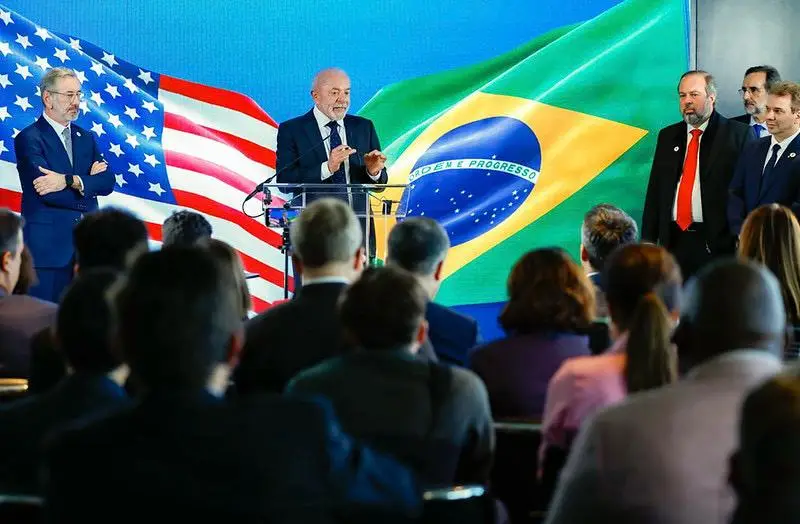
Lula says Trump should not interfere in the 2026 Brazilian election
After meeting at the White House, president says he trusts that the dispute will be decided “by the Brazilian people”
Casarãos recalled that, in addition to the tariffs, the US opened commercial investigations against Brazil, restricted visas for Brazilian authorities and applied sanctions against Alexandre de Moraes based on the Magnitsky Law.
Still, the professor argues that the excess of measures ended up limiting the American ability to continue escalating the conflict.
“What surprised me was that, by using up all the ammunition at the same time, the United States ran out of options later,” he said.
The crisis that became a narrative
From then on, according to him, a gradual movement to decompress the crisis began. First came private negotiations between diplomats. Then, the partial removal of tariffs. Then, the rollback of other measures previously adopted by the White House. 
“It was clear that exhausting the possibilities of the American government’s toolbox would have to lead to a slightly better situation,” he said.
Casarãos also criticized the alarmist tone that began to dominate part of Brazilian political coverage whenever new diplomatic frictions arose. He cited as an example the episode involving the arrest of Alexandre Ramagem by ICE and the subsequent exchange of measures between Brazilian and American authorities linked to visas and diplomatic credentials.
“Everyone said: ‘It’s going to be the Third World War, it’s the end of the world, Brazil is going to end’. And nothing happened,” he said.
In the professor’s view, part of this distorted interpretation arises from the Brazilian tendency to analyze the relationship with the United States as if the two countries occupied the same strategic weight on the international board.
“We often think of the relationship between Brazil and the United States as if it were symmetrical,” he stated.
Brazil was not a priority for Trump
Casarãos highlighted that, despite Brazil’s regional importance, Washington has other, much more urgent priorities at this time, such as inflation, internal tensions in Trumpism and the war involving Iran. 
“For the United States, Brazil is a footnote,” he stated.
According to him, this helps to explain why Lula’s public criticism of Trump often did not produce proportional responses from the White House, despite the expectations created by political sectors and part of the market.
“Every time Lula spoke about Trump, people commented: ‘Now Trump will react to Lula, now the world will end’. Nothing happened,” he said.
In the political scientist’s assessment, the meeting held this week between Lula and Trump ended up functioning as the consolidation of this process of normalization of relations between the two governments.
Relationship returned to pragmatism
“There is nothing out of line, nothing that we can read as the harbinger of a diplomatic rupture,” he stated.
Casarãos considers, however, that Trump’s unpredictability continues to be a factor of permanent instability. “When it comes to Trump, we never know what the next step is,” he said.
Still, he assesses that the current moment is one of relative stability between Brasília and Washington, especially because there is mutual interest in preserving the relationship.
“The Brazilian government has made it very clear that it is open to conversations and interested in maintaining a positive relationship with the United States,” he stated.
“And I am absolutely sure that at this moment it is also in the American government’s interest to maintain good relations with Brazil”, he concluded.
The Risk Map, the policy program of the InfoMoneyairs every Friday, starting at 5am, on YouTube and your favorite podcast player.