
The advertisement travels faster than medicine: the controversial Chinese promise against diabetes
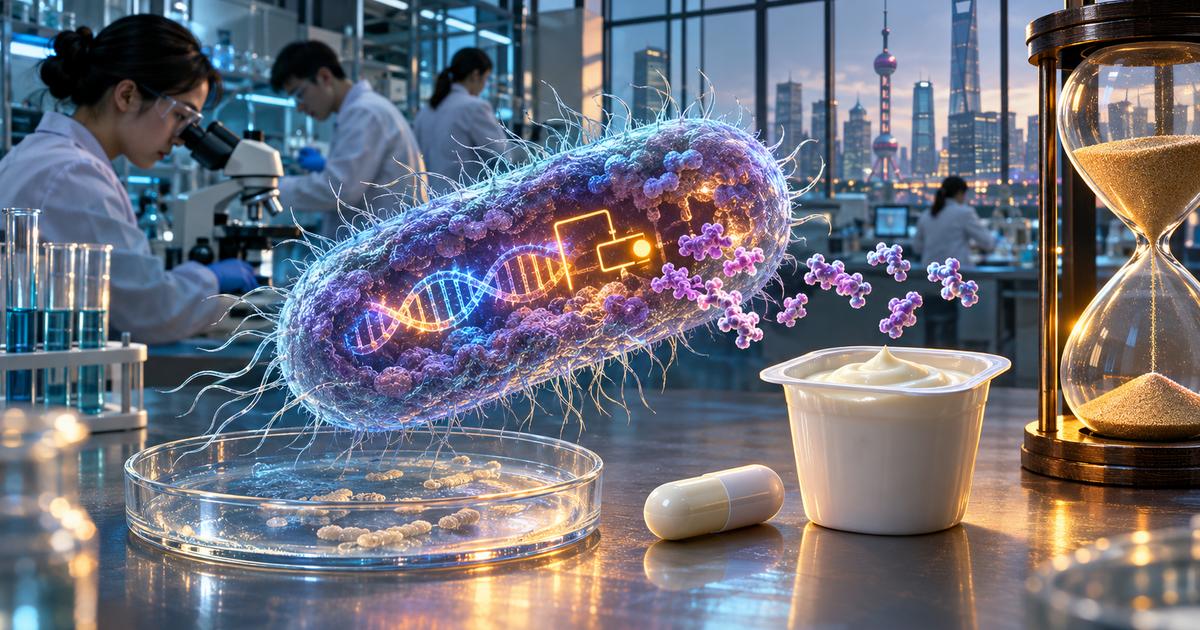
On August 12, 2026, a team from East China Normal University in Shanghai published a work in Naturethe most demanding scientific magazine in the world. They took a common bacteria, the kind that lives in the intestine of any healthy person, and added a genetic circuit to it. This works like a switch, when blood sugar rises above normal, the bacteria lights up and makes a hormone. On the other hand, when glucose returns to its normal level, the body turns off.
This hormone is called GLP-1 and it is the same one that famous remedies against diabetes and obesity imitate. These specialties administer an amount decided in advance, therefore, the bacteria aims to adjust what it produces to the sugar it finds.
The results are encouraging. In diabetic mice, daily treatment for 30 days lowered sugar, improved blood fats and attenuated liver and kidney damage. In monkeys with diabetes, a single dose elevated the hormone and sustained the effect for three days, and repeated administration maintained control for weeks. It is a real achievement of biological engineering.
The contrast between the three-year review in Nature and the promise of over-the-counter sales
There is an administrative data that almost no one looks at, the publication received that job on October 16, 2023 and accepted it on July 14, 2026; There were almost three years of review, of questions, of experiments added at the request of other scientists.
Five days after the dissemination, the researcher who led the team gave an interview to a Chinese scientific newspaper. He said that, if all goes well, the product will be available in the United States in about two years, in the form of a dietary supplement, such as yogurt or a capsule, without a prescription, on the shelf of any store.
Meanwhile, verifying what had already been done took three years, and placing on the market what had not yet been tested on a single person would take two. The second figure did not come from any experiment.
They are two different objects and the reader tends to receive them as one. That is to say, the first one went through months of examination by people who wanted to find errors and the second one did not pass anything.}
Regulatory obstacles in the United States to market a living organism as a supplement
The promise also collides with a law. In the United States, what defines a medication is not the form of the product but its stated purpose. Any substance to treat, cure or prevent a disease falls into the category of medicineregardless of whether it comes in a capsule, in a jar or in a yogurt pot. A dietary supplement, on the other hand, cannot claim to treat a disease. Therefore, if the product is sold as a supplement, it cannot say that it works against diabetes. And if it says it works against this condition, it needs permission from the health authority before the first trial on people. And a modified live bacteria that manufactures a hormone for therapeutic purposes has its own regulatory category in the United States, with its own requirements. Call her supplement It does not make it a supplement.
So the advertised shortcut is a closed door.
The biological challenges of a living drug versus the predictable behavior of a pill
Biology adds its own objections, since a living remedy does not behave like a pill. On the one hand, the tablet It brings an exact amount and you stop taking it when you want. On the other hand, a bacterium It reproduces, and the final amount depends on each person’s intestine, what that individual eats, and other organisms present. It is also not removed with the same ease, and thus the question remains of what happens to a modified organism that leaves the body and reaches the environment through sewage. None of this makes the project unfeasible, it only indicates the size of the pending work. Between what works in a monkey for a few weeks and what works in millions of people for 20 years there is a distance that no emergency can close.
For its part, China maintains a dual regulatory path. An investigator-initiated trial within a large hospital can test a new therapy in a person without review by the national regulator; reaches the ethics committee of the institution itself. This path has its logic, and other countries use similar models to accelerate treatments for rare diseases. It also comes at a cost, and in March 2025 a six-year-old girl received experimental gene therapy in a Shanghai hospital for a non-life-threatening condition. He then died seven days later from an immune system reaction. However, death was not reported, and the team later published only the animal results. The story came to light in July 2026 through a journalistic investigation, not through the system. Likewise, in August a second similar case appeared.
The temptation to outrun safety is not Chinese either. In 1999, an 18-year-old man died in Philadelphia during a gene therapy trial, and that case froze the field for ten years.
That is why the general judgment on Chinese science is both unfair and lazy. Unfair because the economic facts contradict it; American pharmaceutical companies signed at least 32 licensing agreements with Chinese companies in the first seven months of 2026, and are on track to surpass the previous year’s record, and Western companies are currently conducting at least 38 advanced trials of drugs originating in the Asian country. Nobody pays advances of hundreds of millions of dollars per story. Furthermore, it is lazy because distrust due to nationality saves the work of looking at the specific case, which is the only place where the truth is found.
Correct distrust points to something else. Not to the molecule but to the calendar and transparency of the process; as well as who reviewed it.
And there is a rule that the reader can take away and use every time, with any medical advertisement, wherever it comes from. A published job and a promise said in an interview are two different things. The first went through the examination of people who wanted to find errors, but the second did not go through checks. They are almost always advertised together and are rarely worth the same.
Things as they are.
*Mookie Tenembaum addresses international issues like this every week with Horacio Cabak in his podcast El Observador Internacional, available on Spotify, Apple, YouTube and all platforms.