
After more than 20 months of war, Sudan is experiencing ‘the worst humanitarian crisis in the world’
Currently, most of the fighting is concentrated in three areas. In the capital, Khartoum, which is still divided in two but where the army has recovered ground in recent months, as well as in the huge district of Bahri, north of the city center. There was also fighting south of the capital, in the states of Sennar and al-Jazirah, essential for the country’s grain production, and where the FSR is accused of destroying dozens of villages in recent months. And finally, el-Fasher, the capital of North Darfur, on the border with Chad. The last major city in Darfur still in the hands of the army, el-Fasher has been under siege by paramilitaries for 8 months and is probably facing the fiercest fighting of this war. It was in this region that the UN officially declared widespread famine a few months ago.
The United Nations has described the situation in Sudan as the world’s worst humanitarian crisis. At the end of December, the UN refugee agency (UNHCR) counted more than 8.7 million Sudanese displaced in the country. To this number are added 3.2 million refugees who left the country and are in neighboring nations: 1.2 million in Egypt, 900 thousand in South Sudan, 720 thousand in Chad, in addition to Libya, Uganda, Ethiopia and the Republic Central African.
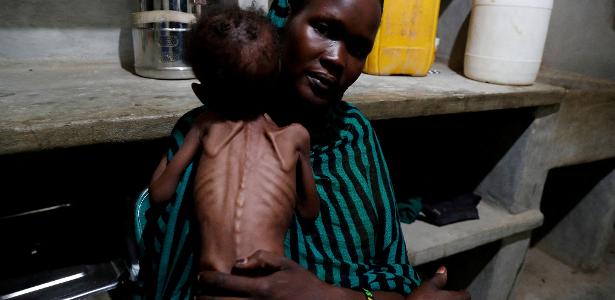
These mass population movements were worsened by food shortages. Officially declared a few months ago in the Zamzam refugee camp, in North Darfur, the famine has now spread to five other regions: three refugee camps in North Darfur, the Nuba Mountains region and the south of the country. A situation that threatens more than 630,000 people, according to a report from the IPC, a food safety classification system used by the UN.
According to Unicef, more than 13 million children are in need of humanitarian assistance.
Humanitarian aid fails to arrive
On April 15, 2024, just a year after the start of the war, France organized a conference of donor countries in Paris that raised ? 2 billion for Sudan (more than R$11 billion at current prices). However, this help arrives slowly. Furthermore, some remember that the financing is not enough, as it is well below the ? 3.8 billion requested by the United Nations.