
Charlie Kirk: How AI is helping to create a digital martyr
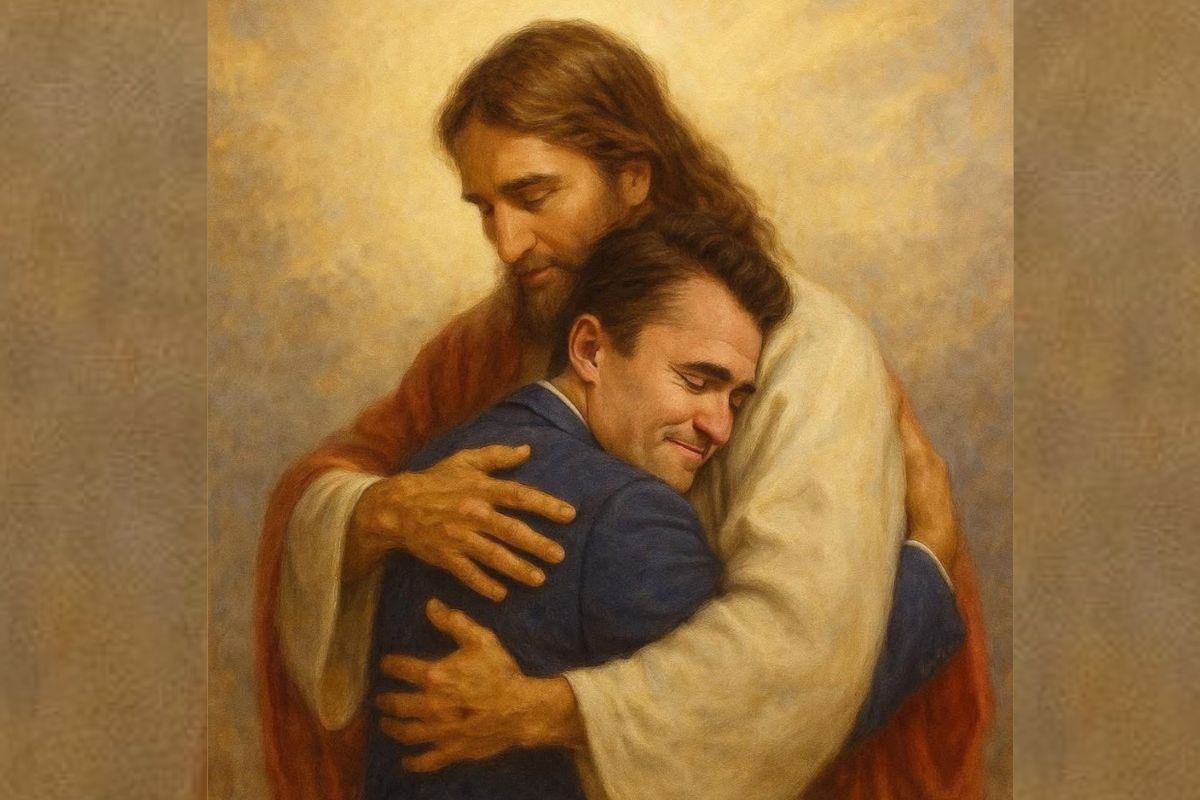
An image generated by circulating on social networks shows Charlie Kirk hugging Jesus. Another portrays him with angel and halo wings. And there is yet another from Kirk alongside George Floyd on the gates of the sky.
When prominent political or cultural figures die in the US, the memory of their lives often tends to hagiography.
And that’s what has been happening since the murder of conservative and co -founder of Turning Point uses Charlie Kirk.
Well Done, My Good and Faithful Servant. pic.twitter.com/gicj6hjrk8
– Ted Cruz (@tedcruz) SEPTEMBER 14, 2025
The term hagiography comes from the Christian tradition of writing about Santos’ lives, but practice often overflows for secular politics and media. Sociology calls this “sacralization of politics”.
Murdens and violent deaths are often interpreted in sacred terms: one becomes a secular martyr who has made a heroic sacrifice.
It is portrayed as morally just and spiritually pure.
This is, to some extent, a natural part of mourning.
But observe more closely why this happens – and how the internet accelerates this process – offers important clues about US politics today.
From presidents to protest leaders
The construction of Ronald Reagan’s posthumous image is a classic example of this process.
After his presidency, Republican leaders cut his memory until he turned it into a symbol of conservative triumph, minimizing scandals such as Iran-Contras or Reagan’s initial skepticism on civil rights.
Today Reagan is remembered less as a complex politician and more as a saint of free markets and patriotism.
Between liberals, Martin Luther King Jr. underwent comparable transformation, though otherwise. Their criticism of capitalism, militarism, and structural racism are often minimized in the most current memories, with a softened image of a peaceful dreamer.
The annual holiday, the renamed streets and the public murals honor him, but also domesticate his legacy in a universally palatable history of unity.
Even more contested figures, such as John F. Kennedy or Abraham Lincoln, show the same pattern. His murders were followed by waves of mourning that raised them to an almost mythical status.
Decades after Kennedy’s death, his portrait hung in homes of many American Catholics, often alongside religious iconography as statuettes of the Virgin Mary.
Lincoln, in turn, has become a kind of Civic Saint: his memorial in Washington, DC, looks like a temple, with words from his speeches recorded on the walls.
Why does it happen and what means
The hagiography of public figures fulfills various purposes. It meets deep human needs, helping mourning communities to deal with loss by providing moral clarity in the face of chaos.
It also allows political movements to consolidate power by sanctifying their leaders and discouraging dissense. And reassures followers that their cause is fair – even cosmic.
In a polarized environment, raising a saint figure makes more than honoring her. Transforms a political dispute into a sacred struggle.
If you see someone as a martyr, then the opposition to your movement is not just disagreement, it is desecration. In this sense, Hagiography is not simply to remember the dead: it mobilizes the living.
But there are risks. Since someone is framed as saint, criticism becomes taboo. The more sacralized the figure, the more difficult to discuss its failures, errors or controversial actions.
Hagiography flattens the story and narrows the democratic debate.
After the death of Queen Elizabeth II in 2022, for example, public mourning in the United Kingdom and abroad quickly raised her legacy the symbol of stability and continuity, with mass taxes, viral images and global ceremonies transforming a complex reign into a simplified history of devotion and service.
This also feeds polarization. If the leader on one side is a martyr, then the other side should be Vilanesco. The frame is simple but powerful.
Read too | Queen Elizabeth dies as the most admired public figure in the country; Charles is the seventh among royalty members, with 42%
Charlie Kirk and Digital Turbo
In Kirk’s case, many of his supporters described him as a figure who sought the truth, with his death by underlining a deeper moral message.
At the funeral ceremony held in Arizona, President Donald Trump called him a “martyr of American freedom.”
On social networks, Turning Point uses and Kirk’s official account in X described it as “the biggest martyr for US freedom of expression.”
In doing so, their death symbol raised broader battles about censorship.
In emphasizing the fact that he died simply for speaking, they also reinforced the idea that liberals and the left would more easily resort to violence to silence ideological enemies, even when evidence points to the opposite.
Read too | Jimmy Kimmel aired after suspension by ABC with Niro in Schedule and censorship attack: “This is anti -American ‘
Industrial scale sanctification
Treating public figures like Santos is not a new thing, but the speed and scale of this process are.
In the last two decades, social networks have transformed the hagiography of a slow cultural evolution to a cycle of accelerated production.
Memes, live broadcasts and hashtags now allow anyone to canonize someone they admire.
When basketball star Kobe Bryant died in 2020, social networks were flooded within hours with devotional, murals and video compilations that presented him as more than an athlete: he became a spiritual icon of perseverance.
Similarly, after the death of Ruth Bader Ginsburg, the “Notorious RBG” meme ecosystem quickly expanded to include digital portraits and products that portrayed it as a sacred defender.
Read too | If the devil wears Prada, the new saint Nike Pants: Influencer Carlo Acutis Canonization unites faith and marketing
Kirk with Jesus Christ: images and audios created with
The same elements surrounded Charlie Kirk. Within hours after his murder, Memes appeared with Kirk covered by an American flag, being carried by Jesus.
In My Opinion Charlie Kirk Was Such a Good Man And Did So Much Of Gods Work That He is not Just Angel in Heaven. He Earned The Spot of Being to Seraphim. Which is the Highest Ranking Angels an angel can Achieve. pic.twitter.com/5nx8p2v7cu
– Brenda Burkley (@kitty628131) SEPTEMBER 14, 2025
In the following days, Kirk AI audios, in the “sermons” style, began to circulate online, while supporters shared biblical verses that claimed to correspond exactly to the time of their death.
Together, these acts frame their death in religious terms: it was not just a political murder – it was a moment of spiritual meaning.
Clips and verses spread easily on social networks, where narratives about public figures can solidify in a few hours, often before the facts are confirmed, leaving little room for nuance or investigation.
Easy memes and videos to create also allow ordinary users to participate in a sacralization process, making it a base effort than something top to bottom.
In other words, digital culture transforms what was once the slow work of monuments and textbooks into a living and flexible popular religion of culture and politics.
Read too | Charlie Kirk: The media trajectory of the activist who dominated the nets with mastery and joined the history of American politics

Towards a clearer policy
Hagiography will not disappear. It meets emotional and political needs effectively.
But recognizing their standards helps citizens and journalists resist distortions. The task is not to deny mourning or admiration, but to preserve space for nuances and accountability.
In the US, where religion, culture, and politics often intertwine, recognize that sanctification in politics is always constructed – and often strategic – can allow people to honor the loss without letting mythification dictate the terms of public life.
This article was originally published in English on the academic portal The Conversation and is republished here under Creative Commons license.
