
Extraordinary discovery: a triple star system just 28 light years from Earth
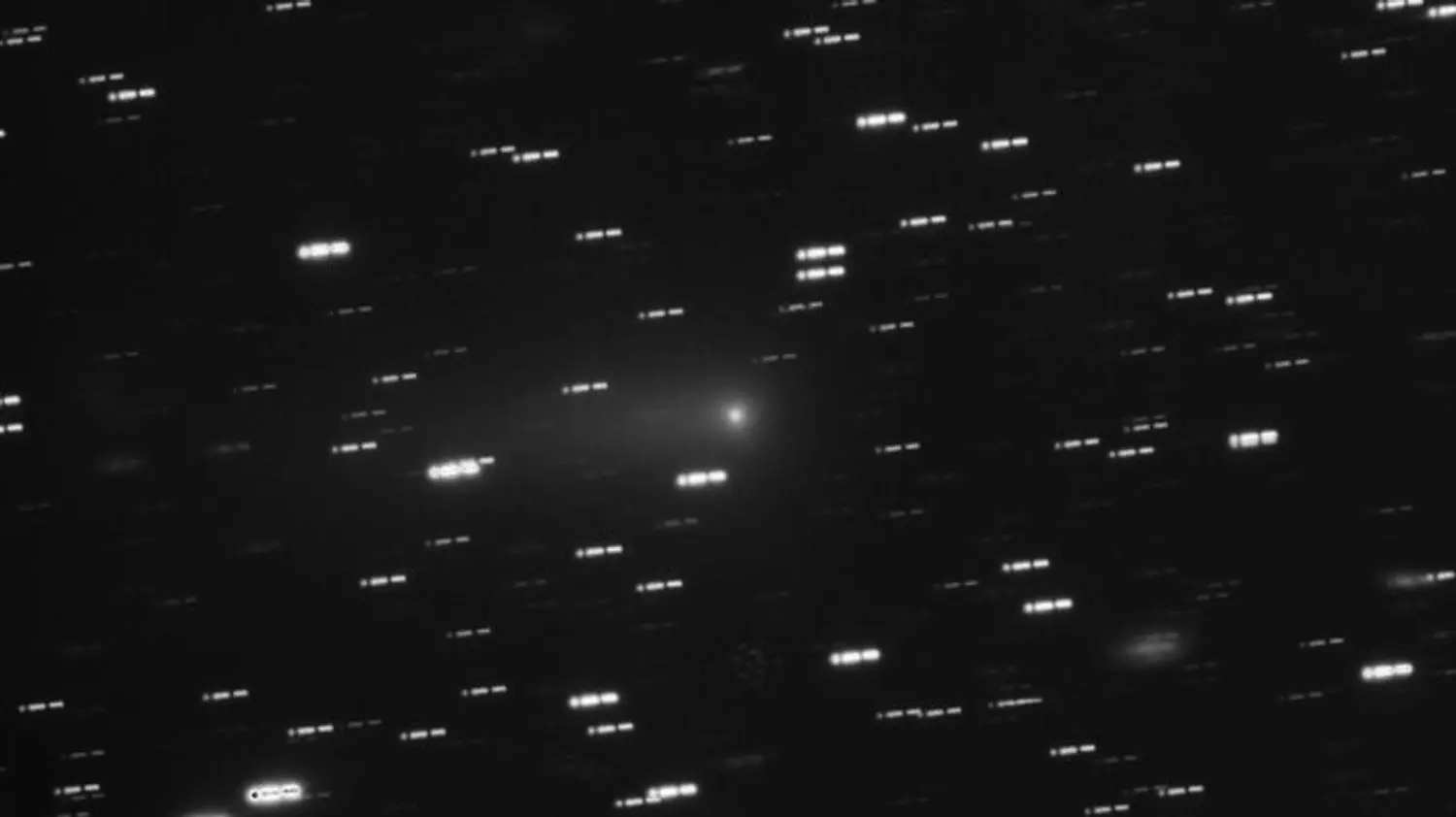
An international team of scientists led by the Trottier Institute for Exoplanet Research (IREx) at the University of Montreal (Canada) has discovered an extraordinary star system just 28 light years from Earth that challenges our understanding of how stars live, die and interact as they evolve.
This unusual triple star system, named Welop*’ai, is detailed in a study published in the journal ‘Astronomy & Astrophysics’.
The system contains two white dwarfs, extremely dense remnants of Sun-like stars that have exhausted their fuel, and one red dwarf, a star much dimmer than the Sun. Scientists stumbled upon this extraordinary configuration, unlike any other known in the vicinity of the Sun, while searching for planets around the red dwarf.
“We were actually looking for planets,” explains Étienne Artigau, IREx researcher and lead author of the study. “Instead, we found something much more surprising.” The discovery began with the SPectropolarimètre InfraROUge (SPIRou) instrument on the Canada-France-Hawaii Telescope on Maunakea, Hawaii. SPIRou is designed to detect exoplanets by measuring the small changes in a star’s velocity caused by orbiting planets.
But a nearby red dwarf behaved differently: scientists detected velocity variations of almost 16 kilometers per second, more than a thousand times greater than expected. After several years of follow-up observations, the team determined that the invisible companion had a mass more than half that of the Sun.
Unusual combination
“The unusual combination of high mass and very low brightness left only one plausible explanation: it was the remnant of a dead star,” explains Charles-Antoine Parent, an undergraduate student at Laval University (Canada) and co-author of the study. “The most likely explanation was a white dwarf, although a neutron star or even a black hole could not be ruled out.”
The team turned to the Gemini North telescope, also located on Maunakea. Using high-resolution images from their ‘Alopeke’ instrument, they directly detected a faint companion: a white dwarf. It was already known that a second, much more distant white dwarf was part of the system.
Therefore, a red dwarf and a white dwarf orbit close to each other, while the second white dwarf orbits both. No comparable system is known within 100 light years of Earth.
White dwarfs represent the final stage in the lives of most stars, including the Sun, but precise measurements of their masses remain rare. The team measured the mass of the newly identified white dwarf with an uncertainty of less than one percent, providing valuable evidence for models of stellar evolution and the physics of matter at extreme densities.
Before becoming a white dwarf, its companion was a star with a mass about 40% that of the Sun. As it became a giant, it expanded to several hundred times its original size, and the red dwarf must have orbited close enough that a dramatic interaction was practically inevitable.
“It shouldn’t exist”
In many similar systems, the expanding star can engulf its companion or even cause the two to merge. Against all odds, the Welop*’ai red dwarf appears to have survived and remains in a surprisingly wide and stable orbit.
“This system should not exist,” reflects Patrick Dufour, professor at the University of Michigan (United States), specialist in white dwarfs and co-author of the study. “We don’t have a clear explanation for how it got here. That is the question that guides our next observations.”
Among the team’s next goals is to better understand the gravitational interactions between the three stars and determine whether those interactions could help explain the system’s unusual evolutionary history. “Discoveries like this remind us that our cosmic environment still holds extraordinary surprises,” emphasizes Étienne Artigau. “Even when we look for planets, our Universe often has something completely unexpected in store for us.”
The name Welop’ai came about through A Hua He Inoa (“Invoking a Name”), a program of the ‘Imiloa Astronomy Center of Hawaii. Welop’ai combines welo (an inherited or familial trait) and p’ai (a circular orbit or path) -, evoking a “path of familial traits”.