
Jurassic dragon discovered in England with trace of last meal
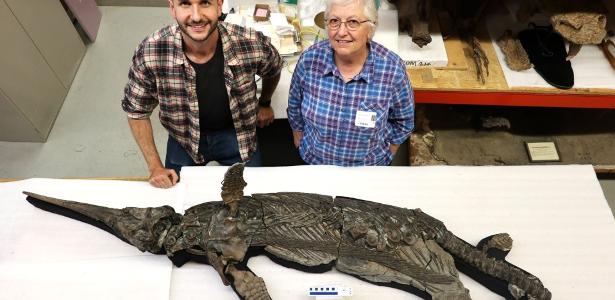
The nearly three-meter-long skeleton is so well preserved that scientists believe it still contains traces of the animal’s last meal. The study was led by paleontologist Dean Lomax, from the University of Manchester and the University of Bristol, and published in the scientific journal Papers in Palaeontology. According to the team, the find represents the first genus of Lower Jurassic ichthyosaur described in the region in more than a century.
I did not expect it to play such an important role in filling a gap in our understanding of a complex faunal turnover during the Pliensbachian. This period is crucial for ichthyosaurs, as several families became extinct and new ones emerged. Xiphodracon is what you might call the ‘missing piece of the ichthyosaur puzzle’ Dean Lomax, paleontologist, in a statement
A rare and decisive discovery
The fossil was stored for years at the Royal Ontario Museum, in Canada, until it was studied in detail. Specimens from the Pliensbachian period (between 193 and 184 million years ago) are extremely rare, and the new fossil helps reconstruct a critical moment in marine evolution.
The two faunas, before and after the Pliensbachian, are very distinct, with no species in common, even with similar ecology. Clearly, a major shift in species diversity occurred during the Pliensbachian. Xiphodracon helps determine when this happened, but we still don’t know why. Judy Massare, professor at the State University of New York