
‘Never killed so many journalists in such a short time’
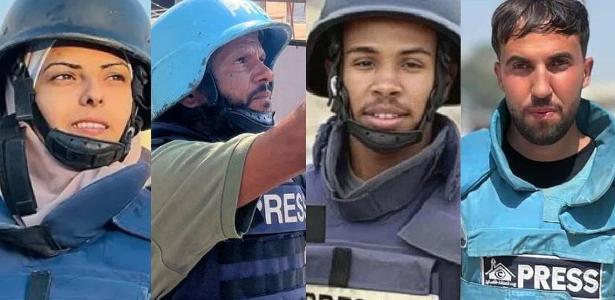
What Reporters Without Borders has been pointing out since the beginning of the conflict, by the way, is that these numbers are not random, not isolated cases, they are to some extent part of a broader media blackout strategy. This is how RSF has been naming this situation, not only for direct attacks on journalists, but also for attacks against international agencies in the city of Gaza, the fact that it prevents the entry of international correspondents to cover the conflict, from making it difficult for professionals who have been there, almost two years ago, working in this context.Artur Romeu, director of RSF
‘RSF denounces Israel to the International Criminal Court,’ says Artur Romeu
Reporters Without Borders denounced Israel to the International Criminal Court for War Crimes. The entity denounces attacks and systematic restrictions to silence testimonies in Gaza.
The reporter without borders even filed four complaints from the International Criminal Court against Israel so that the crimes, the attacks and the cases in which we were able to raise information that journalists were deliberately targeted by Israeli forces for war crimes, precisely, ending an absolute and total disrespect in relation to the humanitarian international law that protects the role of journalists in this context.
Artur Romeu
Our expectation and the pressure we have been making about this situation is to respond to the height, that is, a scenario in which these facts that have this proportion is very serious, they remain without an appropriate response.
Artur Romeu
‘Criminalization’ of journalism and authoritarian governments
Artur Romeo relates the criminalization of journalism in Gaza to a worldwide trend, driven by authoritarian governments and leaders such as Trump and Bolsonaro.
I think the scenario of stigmatization of criminalization of a discourse that will undermine the credibility of press work, which will question the role of journalism, even not only in the figure of specific media or specific journalists, but the very idea of journalism, is part of the prescription of this agenda of a growth of nationalist authoritarianism in various parts around the world. Much from a far-right logic, it is impossible not to talk about Donald Trump in this scenario, which, for example, one of the journalists who was killed yesterday is a collaborator of AP, and we see within the United States the government the government putting a discourse of systematic stigmatization, delegitimation. We saw this in Brazil, during the government of Bolsonaro, Hungary, Poland, Turkey, in different countries, when it is as if this public posture hostile to the press were part of a political strategy to somehow advance certain government agendas and to reduce public scrutiny to which these governments are confronted by the role of the press and journalists in general.
Artur Romeu
