
Two years of war in Gaza: daily life between hunger and ruins
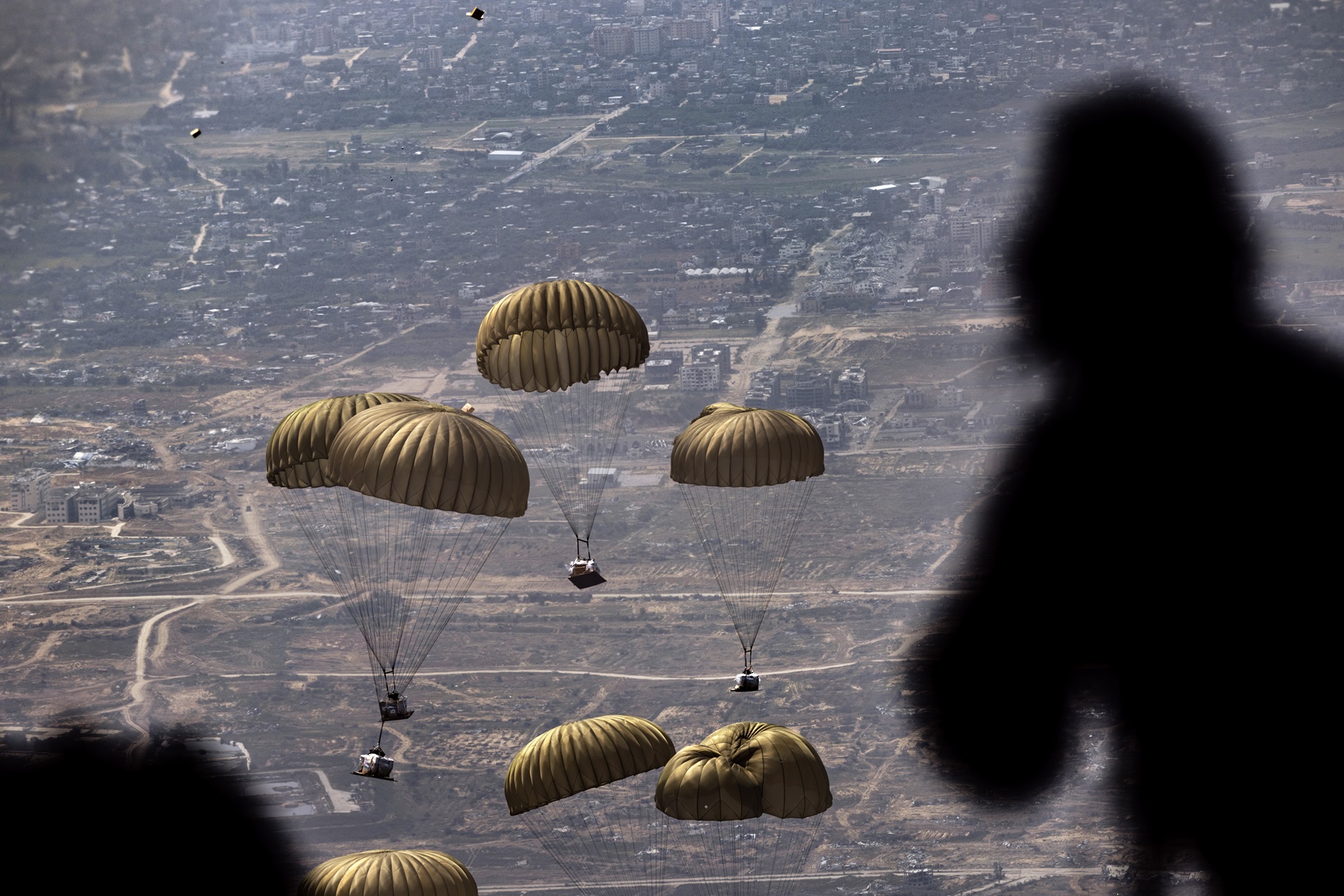
The humanitarian aid pallets fell by parachute, opening onto the hungry and exhausted population of the Gaza Strip.
On the ground, most people were forced to leave their homes and concentrate in a small part of the territory. In tent camps, they struggle to get food, water and medicine. Many homes, businesses and neighborhoods that made up their former lives were destroyed, leaving little to return to when the war ended.
In the two years since Hamas’ attack on Israel on October 7, 2023, Israel has launched a large-scale military offensive in Gaza, causing destruction without recent parallels. The result is a unstructured society. More than 67,000 people were killed — equivalent to 1 in every 34 residents — according to local health authorities.
Last month, a United Nations commission concluded that Israel committed genocide against Palestinians in Gaza. Israel denies the accusation and says its objective is to destroy Hamas and recover hostages captured in the attack led by the group, which killed 1,200 people.
On Monday, Israeli and Hamas negotiators held talks in Egypt about a possible exchange of Israeli hostages for Palestinians held in Israel. An agreement could boost President Donald Trump’s new plan to end the conflict after several failed attempts.
Still, it is unclear who — if anyone — would administer the territory or finance the reconstruction of lives in Gaza.
Meanwhile, most struggle just to survive.
“Thinking about life after the war is only possible when the war ends,” said Hamza Salem, a former gas station attendant who lost both legs in Israeli bombing at the start of the conflict.
Injured bodies, destroyed lives
Before the war, Salem lived in northern Gaza with his wife and four children. The youngest, 5-year-old Rital, liked making beaded bracelets and had just started kindergarten.
“Life went on, thank God,” he said.
Everything changed with the war.
In the first weeks of the conflict, an Israeli attack struck near Rital, severing his right arm, according to Salem and his father, Abdel-Nasr Salem, who was also injured in the explosion. The Israeli army said it had attacked Hamas’ military infrastructure.
Three months later, already taking refuge in southern Gaza, Salem was hit again and had to have both legs amputated above the knee.
Both face difficulties receiving treatment as Gaza’s healthcare system has collapsed.
Israeli forces have repeatedly evacuated, invaded and bombed hospitals, claiming that Hamas uses them as shelters. Less than half of Gaza’s 36 hospitals are partially functioning, according to the World Health Organization (WHO).
As the war progressed, medicines became scarce, and cancer and dialysis treatments virtually disappeared. After Israel blocked all incoming humanitarian aid in the spring, famine spread. In August, international experts said more than half a million people were facing “man-made famine,” with cases of acute malnutrition and deaths from starvation.
Malnutrition and trauma can affect the physical and mental development of a generation, experts warn.
“Children face the risk of becoming ill or dying every day,” said Tess Ingram, UNICEF spokeswoman in Gaza. “This level of toxic stress is not just harmful — it can be fatal in the long term.”
Israeli authorities downplay the severity of the famine, saying they are working to allow aid to enter. The government called the famine report an “absolute lie”.
The Israeli Army claims that it only attacks military targets and follows international law. It accuses Hamas of building command centers, weapons depots and combat tunnels in densely populated civilian areas, as well as arming homes and streets.
According to the WHO, more than a quarter of the 167,000 injured in Gaza suffered “injuries with permanent impact” and more than 5,000 lost limbs.
With the borders closed, residents are unable to escape the bombings or seek treatment abroad.
Rital’s arm could not be reimplanted, Salem said. Due to a lack of hospital supplies, he had to buy anesthesia and medicine from local pharmacies.
The explosion that injured him left him unconscious. When he woke up, ten days later, his legs were gone.
Without adequate medication, he developed an infection and was released from the hospital in severe pain.
The family fled again in September, after a new Israeli offensive on Gaza City. They walked to the central region, pushing the wheelchair through streets of sand and debris.
Today, they take shelter in Salem’s sister’s house, without money, clothes or tents in case they need to flee again.
“We have nowhere else to go,” he said.
Communities in ruins
The UN estimates that almost 80% of Gaza’s buildings have been damaged or destroyed. In December, the agency estimated more than 50 million tons of debris — the equivalent of 105 trucks working for 21 years to clean it all up. In February, the World Bank estimated physical damage at $29.9 billion, 1.8 times the combined annual GDP of Gaza and the West Bank.
But the numbers don’t capture everything that was lost. Erase everyday landmarks — the grocery store, the cafe, the barbershop — and life as it was also disappears.
For Nidal Eissa, father of three and owner of a bridal shop in Gaza City, life revolved around the building where he lived with 30 relatives. Today, it is in ruins, as are the orchard and businesses in the neighborhood.
“I lived my best days in this house,” said Eissa, 32 years old.
The family celebrated births and weddings there. The building was destroyed in August after Israeli bombing. Eissa and her relatives managed to escape in time after a neighbor’s warning.
Now, they live in a tent in southern Gaza.
“If the war ends and there is a change in the regime, I will open a business and stay in my country,” he said. “The most important thing is to change the system that led us to destruction.”
Lost childhoods
Mahmoud Abu Shahma, 14, lives in a tent near the beach. He spends his mornings fetching water, making tea over a wood fire and eating bread with spices — or whatever he can find. He has been out of school for more than two years.
“If there was school, I would go,” he said.
His parents were killed, leaving him among thousands of war orphans.
According to the Palestinian Authority, more than 39 thousand children have lost at least one parent; 17 thousand lost both.
Shahma lives in one of seven camps housing more than 4,000 orphaned children in southern Gaza. Another 15,000 depend on these camps to eat and receive basic care.
Aid workers report frequent cases of anxiety, nightmares and children who have stopped speaking after severe trauma.
More than 700 thousand children are without formal education. Almost all schools need reconstruction, and all universities are closed, many destroyed.
Makeshift schools appear in camps. The NGO Mayasem, for example, offers basic classes in Arabic, English, mathematics and science.
“Here, they can feel like children,” said Najla Abu Nahla, director of the organization.
A collapsing economy
Before the war, Mona al-Ghalayini was one of the few prominent businesswomen in Gaza. She owned a supermarket, a restaurant and the luxury Roots hotel, on the seafront.
Today, almost nothing remains.
“The supermarket was looted and burned. The restaurant is gone. The hotel needs to be rebuilt from scratch,” he said by phone from Egypt, where he took refuge at the start of the conflict.
She opened a Palestinian restaurant in Cairo and says she wants to return, one day, “when there is stability, water and light — the components of life.”
Gaza was already poor before the war, under partial blockade by Israel and Egypt. Even so, local businessmen invested in shopping malls, restaurants and farms. The war paralyzed all formal activity, and unemployment exceeds 80%, according to the World Bank.
More than 70% of irrigation wells, greenhouses and fishing boats have been destroyed, and less than 2% of agricultural land remains accessible.
The “multidimensional poverty” index, which considers income, education and access to basic services, is expected to rise from 64% to 98%.
Among those trying to get back on their feet is Hassan Shehada, 61, owner of a clothing factory that employed more than 200 people. One of his studios was destroyed, and another cannot operate due to lack of electricity.
Still, he holds out an unlikely hope:
“Israel cannot give up on us, and we cannot give up on Israel,” he said. “Without real and lasting peace, nothing will work.”
.