
Why the world’s biggest powers can’t stop a war in the Middle East

Over nearly a year of war in the Middle East, the great powers have proved unable to stop or even significantly influence the fighting, a failure that reflects a turbulent world of decentralized authority that appears likely to endure.
On-again, off-again negotiations between Israel and Hamas to end fighting in the Gaza Strip, driven by the United States, have been repeatedly described by the Biden administration as on the verge of a breakthrough, only to fail. The current Western-led attempt to avoid an all-out war between Israel and Hezbollah in Lebanon amounts to a race to avoid disaster. Its chances of success appear deeply uncertain following the death of longtime Hezbollah leader Hassan Nasrallah on Friday.
“There is more capacity in more hands in a world where centrifugal forces are much stronger than centralizing forces,” said Richard Haass, president emeritus of the American Council on Foreign Relations. “The Middle East is the main case study of this dangerous fragmentation.”
The death of Nasrallah, Hezbollah’s leader for more than three decades and the man who built the Shiite organization into one of the world’s most powerful non-state militaries, leaves a vacuum that Hezbollah will likely take a long time to fill. It is a major blow to Iran, Hezbollah’s main supporter, which could even destabilize the Islamic Republic. Whether all-out war will come to Lebanon is still uncertain.
“Nasrallah represented everything for Hezbollah, and Hezbollah was the forward arm of Iran,” said Gilles Kepel, a leading French expert on the Middle East and author of a book on the global turmoil since October 7. “Now the Islamic Republic is weakened, perhaps mortally, and we wonder who can even give Hezbollah an order today.”
For many years, the United States was the only country that could exert constructive pressure on both Israel and the Arab states. They engineered the 1978 Camp David Accords that brought peace between Israel and Egypt, and peace between Israel and Jordan in 1994. Just over three decades ago, Prime Minister Yitzhak Rabin of Israel and Yasser Arafat, president of the Organization for the Liberation of Palestine, shook hands on the White House lawn in the name of peace, only for the fragile hope of that embrace to steadily erode.
The world, and Israel’s main enemies, have changed since then. America’s ability to influence Iran, its implacable enemy for decades, and those in Iran such as Hezbollah, is marginal. Designated as terrorist organizations in Washington, Hamas and Hezbollah effectively exist beyond the reach of American diplomacy.
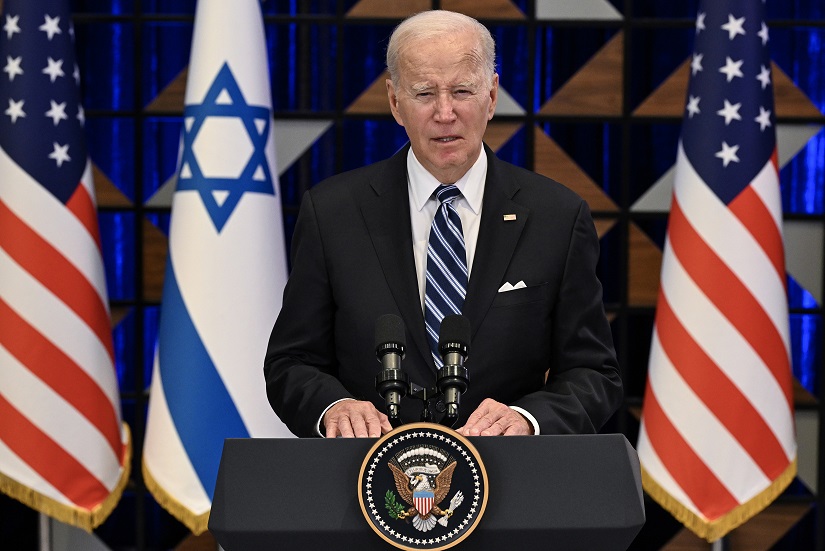
The United States has lasting influence over Israel, notably in the form of military aid that involved a $15 billion package signed this year by President Joe Biden. But an unshakable alliance with Israel, built around domestic strategic and political considerations as well as the shared values of two democracies, means that Washington will almost certainly never threaten to cut off — let alone cut off — the flow of arms.
Israel’s overwhelming military response in Gaza to Hamas’ Oct. 7 massacre of Israelis and capture of some 250 hostages drew mild rebukes from Biden. He called Israel’s actions “exaggerated,” for example. But American support for its struggling ally has been steadfast as Palestinian casualties in Gaza have risen to the tens of thousands, many of them civilians.
The United States, under any conceivable presidency, is not about to abandon a Jewish state whose existence has been increasingly questioned over the past year, from Americans to the streets of the very Europe that embarked on the annihilation of the Jewish people less than a century.
“If U.S. policy toward Israel were to change, it would only be at the margins,” Haass said, despite growing sympathy, especially among young Americans, for the Palestinian cause.
Other powers have essentially been bystanders as the bloodshed spreads. China, a major importer of Iranian oil and a major supporter of anything that might weaken the American-led world order that emerged from the ruins in 1945, has little interest in assuming the mantle of peacemaker.
Russia also has little inclination to be helpful, especially in the run-up to the November 5 US election. Dependent on Iran for defense technology and drones in its bitter war in Ukraine, it is no less enthusiastic than China about any sign of American decline or any opportunity to bog it down in a Middle Eastern quagmire.
Based on his past behavior, former President Donald Trump’s potential return to the White House is likely seen in Moscow as the return of a leader who would be complacent toward President Vladimir Putin.
Among regional powers, none is strong enough or committed enough to the Palestinian cause to confront Israel militarily. In the end, Iran is cautious because it knows that the cost of an all-out war could be the end of the Islamic Republic; Egypt fears a huge influx of Palestinian refugees; and Saudi Arabia seeks a Palestinian state, but would not put Saudi lives at risk for that cause.
As for Qatar, it financed Hamas with hundreds of millions of dollars a year, which went in part to building a labyrinthine web of tunnels, some more than 70 meters deep, where Israeli hostages were held. He had the complicity of Israeli Prime Minister Benjamin Netanyahu, who saw Hamas as an effective way to undermine the Palestinian Authority in the West Bank and thus undermine any chance for peace.
The October 7 disaster was also the culmination of the cynical manipulation, by Arab and Israeli leaders, of the Palestinian quest for statehood. A year later, no one knows how to pick up the pieces.
So on their annual pilgrimage, now underway, world leaders head to the United Nations General Assembly meeting, where the Security Council is largely paralyzed by Russian vetoes on any resolutions related to Ukraine and by American vetoes on resolutions related to Ukraine. Israel.
Leaders hear Biden describe, once again, a world at a “tipping point” between growing autocracy and troubled democracies. They hear UN Secretary-General António Guterres deplore the “collective punishment” of the Palestinian people — a phrase that infuriated Israel — in response to “the abominable acts of terror committed by Hamas almost a year ago.”
But Guterres’ words, like Biden’s, seem to resonate in the strategic vacuum of a world order suspended between the end of Western domination and the faltering rise of alternatives to it. The means to pressure Hamas, Hezbollah, and Israel at the same time—and effective diplomacy would require influence over all three—do not exist.
This development without reconstruction prevented effective action to stop the Israel-Hamas war. There is no global consensus on the need for peace or even a ceasefire. In the past, war in the Middle East led to sky-high oil prices and falling markets, forcing the world’s attention. Now, said Itamar Rabinovich, a former Israeli ambassador to the United States, “the attitude is, ‘OK, so be it.’”
In the absence of a coherent and coordinated international response, Netanyahu and Yahya Sinwar, the leader of Hamas and mastermind of the October 7 attack, face no consequences in pursuing a destructive course, the end point of which is uncertain but which will certainly involve the loss of more lives.
Netanyahu avoided a serious American effort to normalize relations with Saudi Arabia, perhaps the most important country in the Arab and Islamic world, because its price would be some serious commitment to the establishment of a Palestinian state, the very thing he dedicated his life to. policy to prevent.
Netanyahu’s interest in prolonging the war to avoid a formal reprimand for the military and intelligence failures that led to the October 7 attack—a catastrophe for which ultimate responsibility lies at the prime minister’s desk—complicates any diplomatic effort. As was his attempt to avoid facing the personal fraud and corruption allegations against him. He is playing a waiting game that now includes offering little or nothing until Nov. 5, when Trump, whom he considers a strong ally, could be elected.
Israeli families who send their children to war do not know how committed their commander in chief is to bringing these young soldiers home safely, seizing any viable opportunity for peace. This, many Israelis say, is corrosive to the soul of the nation.
As for Sinwar, the Israeli hostages he holds give him influence. His apparent indifference to the enormous loss of Palestinian life in Gaza gives him considerable power over world public opinion, which has progressively turned against Israel as more Palestinian children are killed.
In short, Sinwar has little reason to change course; and, in what Stephen Heintz, president of the philanthropic organization Rockefeller Brothers Fund, called “the age of turbulence,” the world is not about to change that course for him.
“The institutions that have guided international relations and global problem-solving since the mid-20th century are clearly no longer capable of dealing with the problems of the new millennium,” Heintz wrote in a recent essay. “They are inefficient, ineffective, anachronistic and, in some cases, simply obsolete.”
This has also been a lesson of the year since Hamas attacked.