
Billionaire says debt is just the beginning of turbulence that will reshape the US
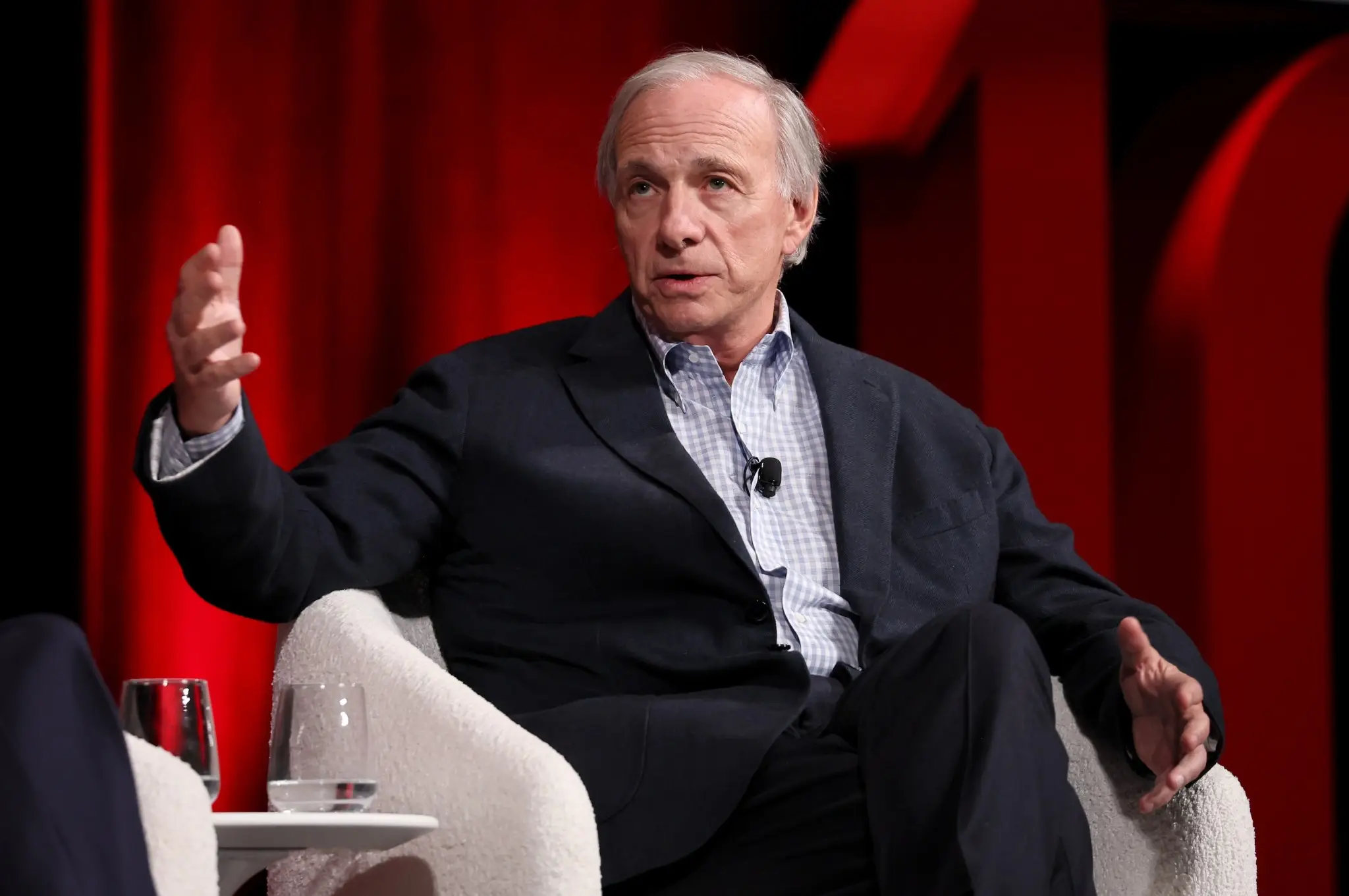
Ray Dalio has been warning for years that America’s debt problem could trigger an economic “heart attack.” Now, he says that’s just part of the story.
The billionaire founder of Bridgewater Associates amplified his warning in a recent conversation with The New York Times’ Ross Douthat, arguing that the U.S. is entering a period of “great turbulence” so severe that the country will be “almost unrecognizable” in five years. He describes the coming era as a kind of “time leap” — an expression that conveys how disorienting and rapid this transformation can be.
Also read: US is losing credibility as a global power, says Ray Dalio
The “heart attack” is yet to come
Dalio’s fiscal warning remains as severe as ever. Currently, the U.S. spends about $7 trillion a year while bringing in about $5 trillion — a difference that leaves the federal government paying billions a week in debt service alone and has left the country carrying a debt equivalent to roughly six times its income.
He compares the situation to “plaque build-up” in an artery: there has been no heart attack yet, but the country’s financial “magnetic resonance imaging” suggests one will come if spending is not contained.
(In practice, Dalio underestimated how much the U.S. pays in interest per week: The Peter G. Peterson Foundation reports that the country will pay $970 billion in interest in 2025, while the CBO projects $1.039 trillion in 2026 — which equates to approximately $19 billion to $20 billion per week.)
In Dalio’s view, the most likely outcome is a stagflationary spiral similar to that of the 1970s, in which the Federal Reserve ends up being forced to issue money to meet its obligations.
“My grandchildren and great-grandchildren who aren’t even born yet are going to end up paying off this debt in devalued dollars,” Dalio told David Rubenstein earlier this year — a comment that reinforces his belief that the impact will not be sudden, but slow, distributed and inevitable for future generations.
Debt is just one of the five forces
What makes Dalio’s latest warning broader than his previous tax warnings is the set of factors surrounding it.
Both he and Treasury Secretary Scott Bessent have advocated reducing the deficit to 3% of GDP as a structural solution — a goal that receives rare bipartisan respect in financial circles but remains far from Washington’s current trajectory.
According to Dalio, the debt crisis is converging with four other forces that are reaching the limit at the same time:
- Internal political conflictwith wealth inequality at historically high levels and what he calls “irreconcilable differences” between left and right — a tension that he says could evolve into broader disorder before the next presidential election, considering there are more guns in the US than people.
2. International rivalryincluding tensions between the US and China and possible points of escalation involving Iran and the Strait of Hormuz.
3. Natural eventsincluding climate-related impacts, which put pressure on already overstretched federal budgets.
4. Artificial intelligencewhich he sees at the same time as a possible lifeline — a leap in productivity capable of overcoming debt growth — and as a destabilizing threat that could displace millions of workers and be used as a strategic tool by rival countries. Dalio wrote for Fortune that “the days of people making decisions in their own heads are coming to an end” as AI reshapes economies and power structures.
Taken together, Dalio calls this convergence the “great cycle” — a pattern he has studied over centuries of the rise and fall of empires and which, he says, the US is experiencing in real time.
The United States’ Suez moment
Perhaps Dalio’s most striking geopolitical warning concerns what happens if the US comes to be perceived as a country losing global influence. In March, he issued a stark warning saying that the conflict between the US, Israel and Iran will be a decisive confrontation around the Strait of Hormuz — and that the outcome will determine whether the US-led global order survives.
He turns to the Suez Crisis of 1956 — the moment when excessive British imperial ambition became unchallengeable and permanently undermined confidence in the pound sterling as a global reserve currency — as a cautionary parallel for the dollar.
If the US fails to convincingly demonstrate its power, the world may quietly begin to question whether the dollar deserves to continue occupying its privileged position.
This fear has gone far beyond Wall Street. Politico, The Telegraph and Middle East Eye published analyzes in March asking whether the US-Iran standoff represented exactly this parallel to Suez.
According to Dalio’s analysis structure, the debt crisis and a possible confrontation in Hormuz are not separate risks, but factors that reinforce each other: a military stumble could precisely accelerate the loss of confidence in the dollar, making the fiscal equation even more difficult to sustain.
Why politicians won’t solve this
Dalio is notably pessimistic about Washington’s ability to respond. According to him, the incentive structure of democratic politics actively works against the difficult decisions required—raising taxes, cutting benefits, and reorganizing spending. Elected politicians who make these decisions are no longer reelected. That’s why they don’t take them.
His proposal for the moment is what he calls “a strong leader from the center” — someone capable of building consensus in a fragmented electorate and implementing structural reforms in education and fiscal policy. Whether such a figure could emerge in the current political environment, he leaves open.
What He’s Telling Investors
For those looking for protection, Dalio’s advice is clearly defensive: diversify and protect yourself against the devaluation of the dollar. He has encouraged investors to go well beyond the traditional portfolio of 60% in stocks and 40% in fixed income, recommending allocating up to 15% to gold and crypto assets as protection against the loss of value of fiat currencies during this period of turbulence.
It’s a sobering message from one of the world’s most closely watched macroeconomic investors. The heart attack, Dalio says, was never the full diagnosis. It’s just a symptom of something much bigger — and the prognosis, without serious intervention, is a country that, at the end of the next five years, will barely resemble the one that once existed.