
Washed? A close call? 4 scenarios for how the US election result could play out
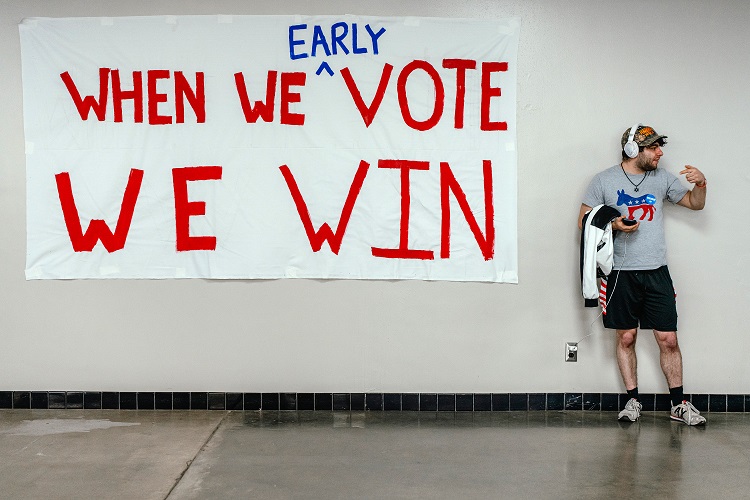
The end of the 2024 American election is close and deeply uncertain.
A reason? On paper, neither side should win.
For Democrats, it’s a classic challenge. In the most recent New York Times/Siena College national poll, just 40% of voters approved of President Joe Biden’s performance, and just 28% said the country was heading in the right direction. No party has ever maintained control of the White House when so small a portion of Americans believe the country is doing well.
Why are US elections on Tuesdays?
Believe me: the answer has to do with carts and farmers

Live: follow the US elections in real time
Americans decide this Tuesday (5) their next president, in an extremely tight race between Kamala Harris and Donald Trump
The challenge for former President Donald Trump is much more unusual, but equally obvious: he is a criminal who tried to overturn the last election. Normally, that would be disqualifying — and Trump still faces several other criminal cases.
To top it off, each side has another major (and largely self-inflicted) vulnerability on an important issue: abortion for Republicans, immigration for Democrats.
Still, one candidate will win this race.
If the final result resembles the polls, all the strengths and weaknesses will more or less cancel each other out, resulting in yet another close election. However, there is reason to think the race could tip one way or the other. The polls may show a tight race now, but they could be wrong either way. Even if the polls are better this cycle, voters may still summarily decide that one side’s responsibilities are more important as they head to the polls.
Here are four scenarios of what could happen in this election. All are plausible—so plausible that each may seem obvious in retrospect.
The repudiation
If Vice President Kamala Harris wins convincingly, we should have seen this coming from the beginning.
Democrats have won election after election since Trump’s upset victory in 2016. They defeated him in 2020, and it’s arguable that things have gone even better for them since January 6th. They stood out in special elections and exceeded expectations in the midterm elections (given the tendency for a backlash against the party holding the presidency). They even did well in this year’s Washington state two-candidate primary — a sort of electoral Groundhog Day for political junkies.
Yes, the electorate is wary of , but the usual rules haven’t applied since January 6, 2021, and the Supreme Court’s decision to overturn Roe v. Wade. Wade. If people enter the voting booth thinking about abortion, January 6, and threats to democracy — as they have in recent years — Harris could win decisively. In the final national Times/Siena poll, she had a 13 percentage point lead on abortion and a 7 point lead on democracy.
Could Trump be repudiated with a decisive defeat? It’s not at all impossible. For starters, there’s a chance that pollsters overcompensated for failing to reach their supporters in the recent election.
Furthermore, Trump’s strength rests on shaky ground. He needs disaffected young, black and Hispanic voters to turn out and vote for a very different candidate than they would have voted for in the past. If these disgruntled voters turn to Harris or simply don’t show up, the race could look different very quickly.
And finally, the race turned to democracy in the final stretch. That’s partly because the election itself naturally raises questions about whether Trump and his allies will accept the results. Trump drew attention to the issue with comments about using the military against an “enemy within.” His former chief of staff, John Kelly, also recently said that Trump fits the definition of a fascist.
The Repetition: 2020
In today’s polarized country, what could be less surprising than a so-so repeat of the 2020 election: another close election in swing states, with little change from four years ago?
After all, Trump is on the ballot for the third time in a row. Voters may be hesitant, but it’s easy to see how they could vote mostly like they did last time, resulting in an outcome very similar to 2020.
That’s essentially what the polls portray today: a small difference of one or two points in the same seven swing states where Biden and Trump finished within a few points of each other four years ago.
You might think a repeat of 2020 means a victory for Harris, but that’s not what I mean. She may win the “2020 repeat” election more times than not, but this scenario is not an exact repeat of the last election. The 2020 race was so close in the Electoral College that it wouldn’t take many changes to change the outcome. Even a slight drop in Harris’ support or turnout among young people, blacks or Hispanics could be enough to put Trump in the lead.
Biden won each of the states of Georgia, Arizona and Wisconsin by less than 1 point — in a repeat of 2020, Harris would need to win at least one of those states to prevail.
Harris could be a slight favorite in a 2020 repeat scenario. But whoever wins, the election would be very close.
The Repetition: 2022
Of the four scenarios, this is perhaps the most difficult to predict. Historically, there isn’t much reason to think that midterm elections have much predictive value for the next presidential election.
However, polls suggest that the 2024 election may look more like the 2022 midterm elections than the 2020 race: an election in which different states, regions, and demographic groups swing significantly, but in different directions. .
First, national polls show a much tighter race than four years ago, even as Harris remains competitive in swing states. This also happened in the 2022 midterm elections, when Republicans won the popular vote but struggled in key states.
Second, many polls show Trump doing well in the same places where Republicans excelled in the midterm elections, such as New York and Florida. On the other hand, Harris is showing more resilience in the relatively white Northern states where Democrats have come out strong in 2022.
Why would the midterm elections have been a harbinger of a changing electoral map? It was the first election after the pandemic and all the unrest that followed — including January 6, the end of Roe, the “woke” debate, a rise in crime and rising prices. Many of these issues were also deeply personal, from school closures and vaccine mandates to feeling like you were being left out of buying your first home.
Unlike many national policy debates, many of these issues have played out differently from state to state. In New York, abortion rights were securely protected by the Democratic government, but a wave of crime hit the subways and new migrants strained the city’s resources. In Michigan, meanwhile, the “stop the fraud” movement was on the rise, and the end of Roe v. Wade threatened abortion rights.
Or maybe Harris is actually doing very well in states like Iowa or Nebraska, where voters have focused on Republican excesses and abortion bans, even though Democrats’ success in Wisconsin and Michigan has strangely helped push abortion off the agenda.
The Restructuring
If Trump wins convincingly, we should have seen this coming from the beginning.
On paper, this election should be a Republican victory. After all, Biden’s approval rating is stuck in the low 30s, voters are convinced the country is headed in the wrong direction, and they don’t believe the economy is in good shape. These are losing numbers for the president’s party, and governing parties have been ousted in election after election around the world.
Signs of a Republican victory have been accumulating for years. For the first time since 2004, high-quality polls show Republicans with an advantage in party identification. Party registration numbers have also been skewed significantly toward Republicans, with registered Republicans poised to outnumber Democrats in the November electorate in every swing state with party registration: Pennsylvania, North Carolina, Arizona and Nevada.
While Democrats have done well in recent low-turnout elections, this is largely due to their support among high-turnout voters. Trump’s more disengaged base is more likely to turn out in this high-turnout election. And in fact, in state after state, early voting is much more Republican than it was in the past. Democrats hope to compensate with stronger turnout on Election Day than in recent cycles, but if they don’t, the election could quickly turn into a rout.
No, the polls don’t show a landslide defeat for Trump, but what could be less surprising than the polls underestimating Trump, just as they did in 2016 or 2020? Researchers have never found a convincing explanation for what went wrong, and the simplest is that they simply can’t reach enough of Trump’s less engaged supporters. Despite their efforts over the past eight years, there may simply be no solution to this problem.