
Tycoon or beautiful, modest and homely? The woman behind ‘Ballerina Farm’
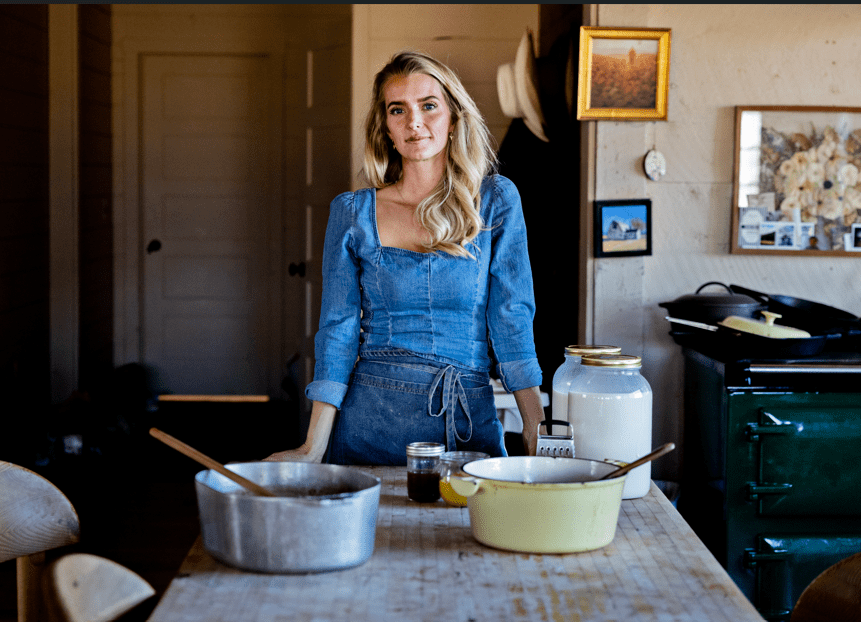
Like many stressed-out home cooks, Hannah Neeleman suddenly realized she had forgotten the final step of her recipe just as she was about to serve it. It was a sunny November afternoon in Kamas, Utah, and she was cooking a pot of stroganoff, made with meat and yogurt from the cows chewing their cud in the barn next door.
“I didn’t add the mustard and Worcestershire sauce,” the condiments that make the creamy dish shine, she said. Entering the pantry, he came out with a glass jar in each hand: homemade versions of both.
It’s not exactly difficult to make your own mustard or Worcestershire sauce, but who would bother? It’s this kind of self-sufficient, all-made-from-scratch attitude that fills Neeleman’s audience with both admiration and irritation. It’s a mix that made her — and her “Ballerina Farm” page — very famous, very quickly.
The name, inspired by her teenage years as a Juilliard-trained dancer, refers to the 328-acre ranch, dairy and family homestead where she and her husband, Daniel, live with their eight children, ages 1 to 12. But “Ballerina Farm” is also Neeleman’s wildly popular social media persona, with nearly 22 million followers across TikTok, Instagram and YouTube — far more than the combined reach of long-established home goddesses Ina Garten, Martha Stewart, Joanna Gaines and Tieghan Gerard.
“I love watching what she does, but sometimes it drives me crazy that she makes it look so easy,” said Carly Weber, an elementary school teacher in Bloomington, Indiana. “I have two kids, I can barely cook one thing most days, and there she is looking perfect and teaching herself how to make mozzarella.”
Since 2021, Neeleman, 34, has been posting videos almost daily as she goes about her work as a chef, bread baker, shepherdess, gardener, egg collector and entrepreneur. She seems so calm about this workload that even fans suspect she is hiding an army of domestic servants. (For the record, the family has help from a part-time nanny and a teacher who homeschools the kids three days a week.)
Neeleman also built Ballerina Farm into a thriving food and homewares brand, a wellness and nutrition center, a model for small farms, and a showcase for her Mormon faith.
In the process, she has attracted many labels: homesteader, model, missionary and tradwife — a term that has gone viral during the pandemic to describe women who glorify traditional roles like wives and mothers. And since a provocative profile of her last summer sparked a global conversation, she’s become a magnet for all sorts of opinions about how women should live.
Is Hannah Neeleman a modern housewife choosing her own path? A deluded prisoner in a gilded cage of faith and family? (Her husband is the son of JetBlue founder David Neeleman and widely assumed to be financially independent.) A privileged influencer whose performative perfection masks the real work involved?
As she went about her day, dressing her daughters in coats and checking on a pen of pregnant Jersey cows, Neeleman serenely navigated these questions, citing family tradition rather than faith or ideology as the force driving her life choices.
“I always knew I wanted to be a mother who provided for her family,” like her own mother, Cherie Wright, who raised nine children (and has 53 grandchildren), she said. “I didn’t know it would be like this, but I’m so proud of what we built.”
A Mormon Tradition
Ballerina Farm’s leap to worldwide fame came in August, when The Times of London published an article that portrayed Neeleman as the frightened victim of a tyrannical husband. Although Neeleman posted a video disputing this version of his life, the internet exploded with harsh criticism of both.
His fans flooded the comments, accusing him of dragging her from ballet to routine. Testers on Substack said she takes advantage of generational wealth and her thin, blonde, white privilege to promote a pronatalist agenda.
Neeleman isn’t one to shy away from the spotlight — she’s competed in beauty pageants since high school, and as recently as last year, when she competed for the Mrs. World crown two weeks after giving birth. She’s on the cover of the current issue of Evie, a kind of Cosmopolitan for conservative women, looking seductive while milking a cow. But she’s new to the type of audience that responds and shows up.
“People stop on the road and take pictures, come up to the entrance, offer to live with us for a week to help with chores,” she said, seeming more surprised than upset that fans don’t always respect the boundaries of her real life.
That real life seems appealing, at least for a day or two. But online, like any influencer’s feed, it’s a carefully curated edit.
She makes donuts from scratch, harvests herbs from her potted garden, and makes time for the occasional pas de bourrée or weightlifting session with her husband. (Her new Ballerina Farm protein line has been one of the site’s best-selling products.) While she’s rolling dough or stuffing grape leaves, sometimes she’s carrying a baby in a carrier or a toddler on her hip; older children often appear in the frame, but they never complain or fight.
This endless stream of too-good-to-be-true content delights its fans and infuriates its critics. But to Neeleman’s mind, she is simply doing what generations of Mormon women, and other women in traditional societies, have done before her. She is the latest in a long line of Mormon home influencers, starting with the “mommy bloggers” of the early 2000s, who quickly adapted their church-sanctioned skills in cooking, baking and housekeeping to the internet.
“The life I always wanted“
Neeleman was raised not far away, in Springville, where her parents ran a flower business. Hannah, the eighth of nine children, says she grew up cooking and foraging with her mother, “a bit of a hippie” who made simple food with fresh ingredients. “I didn’t know what canned spaghetti sauce was,” she said. “I thought it was something you do, not something you buy.”
She learned to dance jazz and tap; When she was 11, a Russian ballet academy came to town and she saw dancers on pointe for the first time. “They were like goddesses,” she said. “I loved his physique and his strength.”
She trained hard and, at age 16, turned down a full scholarship to Brigham Young University to join the prestigious four-year BFA program at the Juilliard School in New York, where she lived in a dorm and worked as a receptionist at Lincoln Center.
“I spent all that money on restaurants,” she said, sampling foods she hadn’t found in Utah: Cantonese dim sum, fresh bagels and French pastries.
She and Daniel Neeleman met during her senior year, and by the time she graduated in 2012, they were married and expecting their first child.
“I always knew ballet wasn’t my goal in life,” she said, pointing out that professional dancers, like professional athletes, tend to have short careers. “This is the life I always wanted.”
On this November day, she looked as tired as most parents of young children, but by no means trapped. Her five daughters were at the local library with a nanny, her three sons were playing outside, and her pride in pressing whole herb leaves between layers of fresh dough was evident.
In their large, open living space, all the furniture was pushed to the edges to give the kids room to run around. One corner housed her famous Aga stove, a British cast-iron stove coveted by cooks that she bought secondhand on Craigslist. (A new Aga this size starts at about $35,000.)
A pot full of snow-white beef suet sat on the counter next to a supply of fresh herbs and an unusually elegant KitchenAid mixer. “Jennifer Garner sent me this,” she said shyly, as if she was worried about appearing like she was showing off.
A well-oiled machine
A knock on the window signaled the arrival of the daily supply of raw milk, two glass jars that Daniel Neeleman held up in his wife’s hands. He is responsible for producing yogurt, a staple in the family’s diet.
Dairy cows produce more milk than the Neelemans can drink; the farm produces more meat than they can sell; sourdough yeast reproduces every day. In this kind of kitchen ecosystem, making beef stew, mozzarella, and waffles daily isn’t necessarily performative; It’s an efficient way to feed a large family.
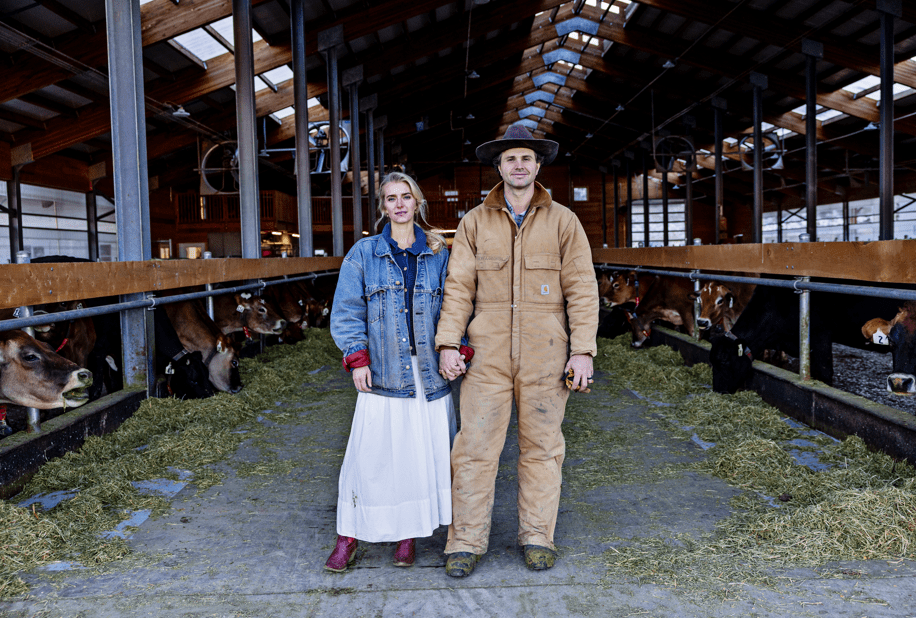
Daniel Neeleman soon appeared in Carhartt overalls and gently ushered a reporter, photographer, Hannah and her head of public relations (hired since the Times of London fiasco) into an SUV to tour the dairy barn. Daniel Neeleman, 36, grew up mostly in Connecticut but is as passionate as only a new farmer can be.
The light, airy space was almost silent, without the usual soundtrack of suction pumps and the mooing of impatient cows. The couple invested $400,000 in a state-of-the-art robotic milking system, which allows each cow to be milked on her own schedule and collects microdata such as the rate at which she chews and the number of steps she takes in a day. Two huge Roomba robot vacuum-like machines roamed the halls, silently absorbing manure, then parking to be emptied.
The next step in Ballerina Farm’s expansion will be a dairy factory, producing butter, cheese and ice cream. To learn the craft, the Neelemans visited top producers such as Maison Bordier in Normandy, Arethusa Farm in Connecticut and the Ballymaloe Cookery School farm in Ireland.
Ballerina Farm has also become a thriving direct-to-consumer business, complete with retro branding and a new tagline: “Healthy Charm for Everyday Life.” What started as a modest shop on TikTok has become a retail hub with 50 employees churning out frozen croissants, fresh garlands, mother-daughter aprons and $298 cowboy boots.
The couple purchased 14 acres in Kamas, where they plan to build an educational farm complete with animals, a visitor center, restaurant and event space to attract day visitors.
“The people of Utah are still very close to their agricultural roots,” said Daniel Neeleman. “Even if they’re living in a townhouse in Salt Lake, on the weekend they want to go out on the land, see what their grandparents did.”
The goal of this entire endeavor, said Hannah Neeleman, is not to accumulate more wealth, conversions or fame, but to bring her followers the joy she experiences in family farming.
“The community gave us all of this,” she said, gesturing to the farm, where a freshly painted barn displayed the new Ballerina Farm logo. “Giving back seems like the least we can do.”
