
Senate approves tougher penalties for violent crimes and text goes to the Chamber
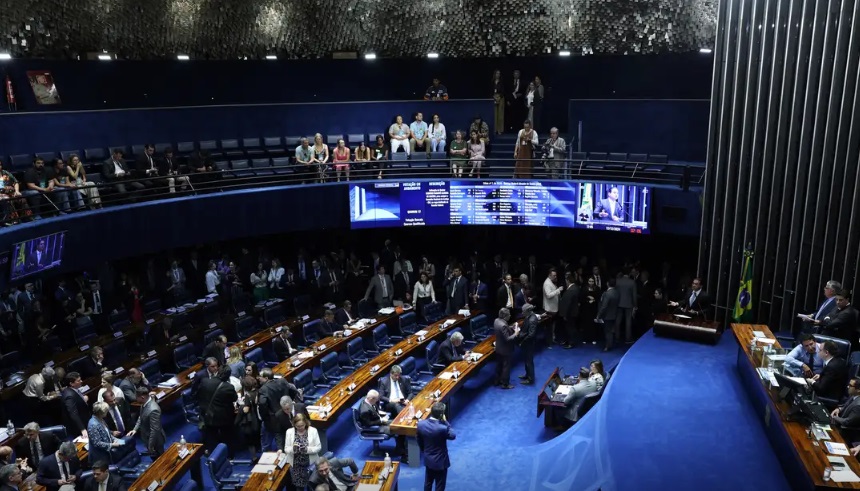
This Tuesday, the 14th, the Federal Senate approved a bill known as the anti-violent crime package. The text toughens the punishment for crimes committed with violence and makes the rules for executing the sentence in these cases stricter.
The project was prepared by the Public Security Commission, chaired by senator Flávio Bolsonaro (PL-RJ), and now goes to the Chamber of Deputies for analysis. The parliamentarian stated that he will ask the president of the House, deputy Hugo Motta (Republicanos-PB), to speed up the processing of the proposal.
According to the text, the crime of robbery committed with a restricted or prohibited firearm now carries a sentence of 8 to 20 years in prison instead of the current 4 to 10 years. Robbery that results in serious bodily injury is now punishable by 10 to 20 years in prison. Currently, sentences range from 7 to 18 years.
FREE LIST
10 small caps to invest in
The list of stocks from promising sectors on the Stock Exchange
PGR rejects request for arrest of Eduardo Bolsonaro made by PT and PSOL deputies
Attorney General Paulo Gonet states that deputies who authored the request do not have procedural legitimacy, but maintains the possibility of future precautionary measures

Government will seek solution for Budget after rejection of IOF MP, says Haddad
Government will seek solution for Budget after MP’s rejection of financial applications, says Haddad
There was also an increase from 6 to 8 years in the minimum sentence for simple homicide, which can reach up to 20 years. In the case of drug trafficking, penalties will be increased by one-sixth to two-thirds if trafficking occurs in squares, neighborhood associations and public transport.
Another important change is the reduction of the limit for the sentence to be served in a closed regime. Today, only sentences of 8 years or more in prison trigger criminal execution in prison. The proposal is to reduce it to 6 years.
Furthermore, those convicted of drug trafficking, militias and criminal organizations will only be able to advance their regime if it is proven that they have paid the fine imposed upon conviction – the exception is if the convicted person can prove that they have no resources.
See the list of crimes that had increased sentences:
- Robbery committed with a firearm of restricted or prohibited use: penalty of eight to 20 years in prison (today it varies from four to ten years, increased by two thirds when a firearm is used);
- Robbery resulting in serious bodily injury: penalty of ten to 20 years in prison (currently ranging from seven to 18 years);
- Extortion to impose contracting of services: penalty increase from a third to half, as already happens for extortion with a firearm. The initial sentence ranges from four to 10 years in prison;
- Constitution of a private militia: penalty of six to ten years in prison (currently four to eight years);
- Reception: penalty of two to six years in prison (currently varies between one and four years);
- Guilty reception (when whoever bought it should assume that it was the product of crime): penalty of one to five years in prison (currently it is one month to one year or a fine);
- Simple homicide: penalty of eight to 20 years in prison (currently six to 20 years);
- Drug trafficking: penalties, which vary, increase by one-sixth to two-thirds when drug trafficking is carried out in squares, neighborhood associations and public transport (currently this rule already applies to prisons, hospitals and schools, for example).
- Robbery committed in association with one or more people or against the transport of valuables and cargo: is now considered qualified robbery, with a penalty of six to 12 years in prison (currently the penalty is four to ten years, with the possibility of an increase of a third to half in the case of transporting valuables or voluntary collaboration of two or more people
