
Tim Scott summons Lutnick and Jensen Huang on December 3 over chips to China and threatens forceful subpoenas
IN 30 SECONDS
- What has happened? The president of the Senate banking committee, Tim Scott, has requested the Secretary of Commerce by December 3, Howard Lutnickand the former CEO of Nvidia, Jensen Huang, with the warning that he will use ‘all instruments at our disposal, including forced subpoenas’.
- Who is behind? The national security wing of the Republican Party in the Senate, with John Kennedy and Kevin Cramer at the helm, after two Axios reports placed Lutnick at the center of the case.
- What impact does it have? The committee that oversees export controls publicly opens the debate on how much American computing capacity can reach China, a decision that conditions the supply of chips to data centers in China. Spain and throughout the EU.
Tim Scott summons Lutnick and Jensen Huang before the Senate over the chips Nvidia sold to China.
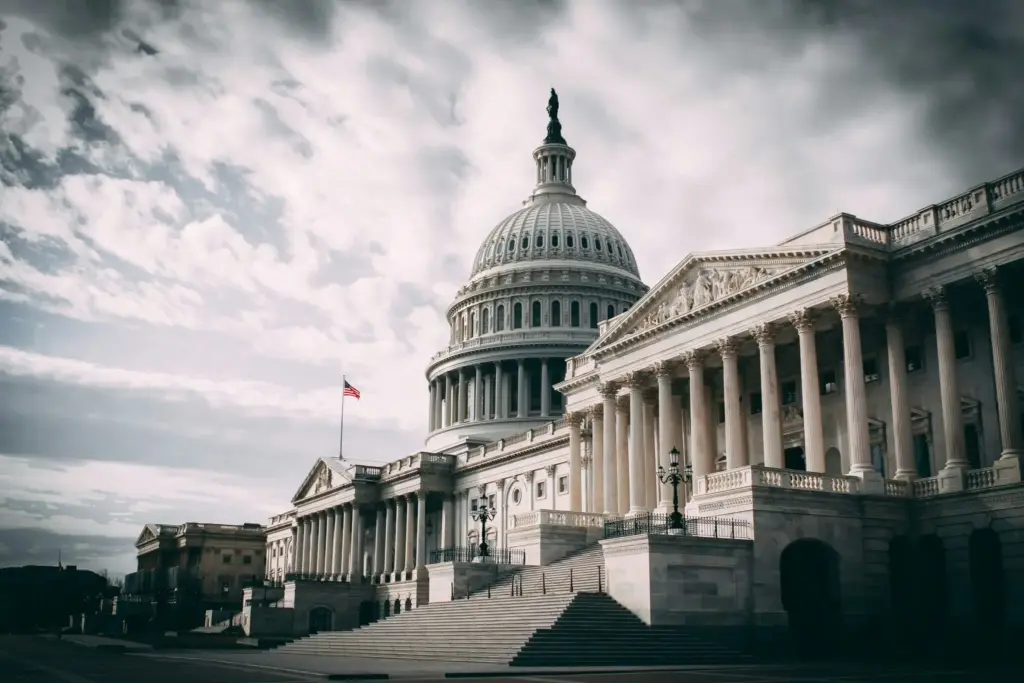
The two letters came out on Thursday and point to the same place: the Senate banking committee, the panel that oversees sanctions, export controls and, incidentally, everything that the United States sells or does not sell to Beijing. Scott chairs it and has not extended a courtesy invitation. He has set December 3 and has warned that, if either of the two does not appear, the committee will use ‘all instruments at our disposal, including forced subpoenas’: the subpoenathe requirement with legal force that requires testimony under oath and that turns silence into obstruction.
The trigger is a resignation at full speed. Jensen Huanguntil Thursday the most influential executive in American technology, left the management of Nvidia after two extramarital affairs became known, one of them with Alice Huang, an executive at Megaspeed, a Singaporean data center firm. He FBI is investigating this link and US intelligence considers that the company has suspicious ties with the Chinese Government. So far, a personal scandal with national security implications. What has turned it into a political crisis is the name that appears next to it.
Everything revolves around a name.
The thread that connects Huang to Lutnick is license. He Department of Commerce issues and enforces export controls through the Bureau of Industry and Security (BIS), the unit that decides which chip can leave, to whom and under what conditions. That’s the committee’s jurisdiction. ‘Given the Department of Commerce’s central role in issuing and enforcing export control regulations, his testimony before the committee will prove essential to our oversight,’ Scott wrote. In the language of the Capitol, that’s a warning: Senate supervision is not negotiated with press releases.
Two Axios reports have placed Lutnick in the center of the picture. The first maintains that the secretary knew about Huang’s relationship with the alleged Chinese spy and still approved the sale of Nvidia chips to Chinese buyers. The second claims that it was the only Cabinet member who resisted to the attempt donald trump to turn off the tap transshipmentthe diversion to Chinese artificial intelligence companies of even more advanced models that were not authorized for China.
Washington does not sell chips to China out of inadvertence: it does so because the alternative was to stay out of the market that finances its own industry.
The permit is being discussed, not the sale.
The Republican knives and the support of the White House
Scott is not alone, and that is the fact that really bothers the Department of Commerce. John Kennedysenator from Louisiana, and Kevin Cramer, from North Dakota, have joined the demand that Lutnick testify. They are both allies of Trump, they both vote with the White House almost always and they both sit on that panel. When that profile requests an appearance under oath, it is not a partisan maneuver: it is the party protecting its national security flank before the opponent occupies it.
The White House supports the secretary. “The president maintains complete confidence in the secretary and his ability to carry out the job,” a senior official said Thursday, before recalling that Lutnick is “a champion of America First trade and tariff policy” who has closed “nearly 20 fair trade agreements and trillions in manufacturing investment.” Is the standard backrest.
It lasts until it stops lasting.
Spain enters this story through the supply door. Training accelerators are not manufactured here: the computing capacity of the data centers that amazon and Microsoft have committed in Aragon, or that of the MareNostrum of the Barcelona Supercomputing Center, depends on buying American GPUs and obtaining, or not, an export license. When the BIS tightens a rule, the schedule for those projects moves.
The Netherlands is the most exposed European partner, according to ASML, but American control is applied extraterritorially to any equipment that carries its own technology, even if it is sold from a European port. Brussels has been negotiating a more predictable licensing framework with the Trump administration for months. Madrid has no known public position on the Huang case, and it does have a declared industrial priority: artificial intelligence and data centers.
The bottleneck is not in Madrid.
Washington Logic
What the Senate stages on December 3 is not a personal reckoning. It is the institutional response to an unsolved problem: trump At the same time, it wants the largest deployment of artificial intelligence infrastructure on the planet and that the most advanced chip does not cross the Pacific. Both things are paid with the same money. Nvidia sells to China what the law allows, and for months it allowed more than the national security wing considered prudent, because every dollar from that market goes back into investment in data centers in Texas, Virginia and Arizona.
The coalition that supports this offensive is not anti-Trump. It’s the wing hawk of the Republican Party in foreign policy, the same one that pushed the October 2022 controls and that now sees in the Huang case proof that the Department of Commerce decides too much alone. The American precedent is at hand: In 1987, Congress staged a hearing with a Toshiba television and a sledgehammer on the steps of the Capitol after the Japanese company sold machine tools to the Soviet Union. From that scandal came the Exon-Florio amendment, the embryo of the current CFIUS. Washington has been monitoring its own sensitive exports for four decades.
For Spain, reading is calendar and portfolio reading. A license that the BIS revises downwards does not appear in the headline of the day: it appears six months later, when a data center in Zaragoza or an expansion of the Catalan supercomputer are queuing behind American and Asian buyers. Madrid has no vote on Scott’s committee, but retains an asset it rarely uses: to be the first European partner that Washington calls when you want to explain a rule before publishing it.
The next window is December 3rd. If Lutnick appears, the committee will for the first time have a public, sworn account of how each license was approved. If you don’t, Scott has already said what’s coming. And the unknown remains that no one in Washington wants to answer out loud: whether the national security criterion is set by the White House, the Senate or a Commerce Department office on Constitution Avenue.
Case File
- The case: The Senate banking committee calls on the Secretary of Commerce and the former CEO of Nvidia following two reports that link the approval of chip licenses to China with an alleged case of espionage.
- Key facts: appearance set for December 3, explicit threat of forced summons (subpoena), two journalistic investigations by Axios and one open investigation by the FBI about the link with Megaspeed.
- For Spain: The supply of GPUs for the Aragón and MareNostrum data centers depends on licenses decided by Washington; Each tightening of the BIS delays Spanish industrial projects already committed.