
Scandal in Armenia: deputies grabbed pine cones and rolled chairs in full Parliament
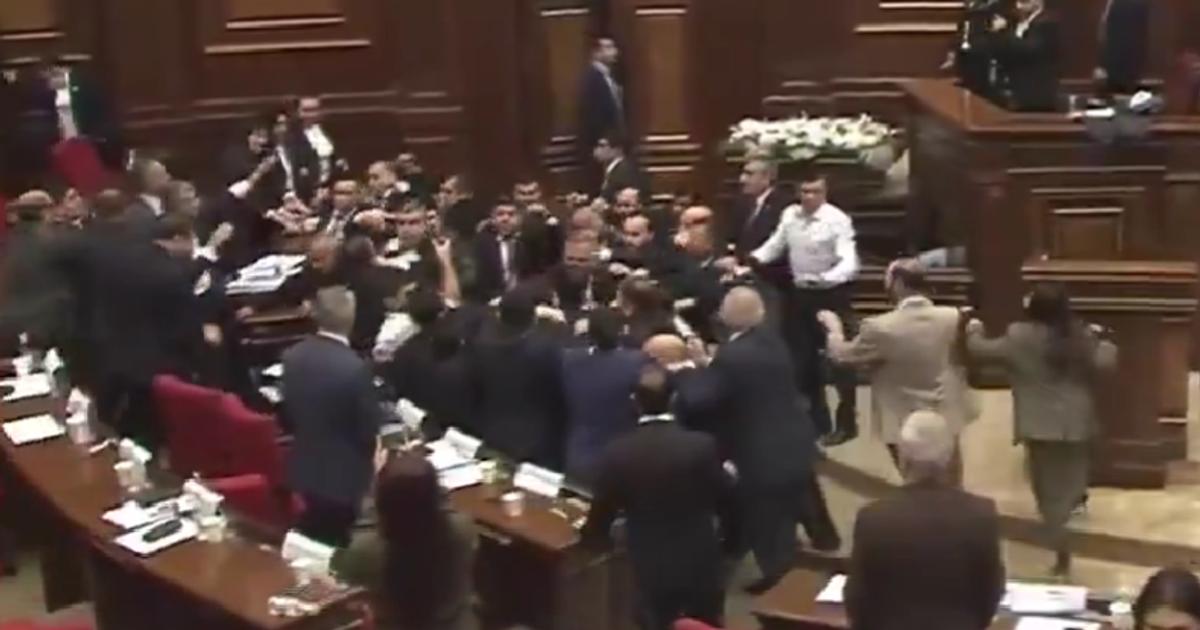
A strong fight between pro-government and opposition deputies shook the Armenian Parliament this Thursday. What began as a political discussion turned into a physical confrontation with hitting, pushing and even throwing a chair. The incidents continued in the hallways of the building, even after authorities called a recess in the session.
The episode involved representatives of the ruling Civic Contract party and the opposition force Strong Armenia. The conflict broke out when the official deputy Tarón Chajoián demanded that the opposition leader Narek Karapetián apologize for some controversial statements made by a family member during the June election campaign.
Karapetian, whose party had been accused of bribery before the parliamentary elections, initially responded from his seat. However, the discussion escalated and the leader approached the platform, where other legislators from both sectors joined.
How the fight between Armenian deputies began
A representative of Strong Armenia pushed Chajoián, who reacted with a blow. Other versions, however, indicated that the first punch would have been thrown by the opposition deputy.
The situation escalated quickly and became a pitched battle. In the midst of the hitting and pushing, one of the legislators even threw a chair towards the opposing group.
The president of Parliament ordered to interrupt the session to try to control the situation, but the measure failed to stop the incidents. The fight moved to the hallways of the building, where security personnel and representatives of other political forces tried to separate the deputies.
The tension reached such a point that, when an ambulance arrived at Parliament, one of the opposition legislators had a bloody nose.
Prime Minister Nikol Pashinian’s reaction
After the confrontation, Strong Armenia blamed the ruling party for what happened. The opposition force was founded by Armenian-Russian businessman Samvel Karapetian, who is under house arrest.
From that space they also questioned that the authorities had not ordered a pause in the session as soon as the conflict began and that they waited for the situation to escalate.
The Prime Minister of Armenia, Nikol Pashinián, came out in defense of the pro-government legislators and rejected any type of aggression against the members of Parliament.
“No one can raise their hand to a deputy,” said the president. Then he added: “Everything has a limit. They must know their place.”
The political conflict and the possibility of a constitutional referendum
In parallel to the dispute between the blocs, Pashinián left open the possibility that the Government and the opposition reach an agreement to call a constitutional referendum.
The consultation is linked to one of the main objectives of Armenian foreign policy: moving towards the signing of a definitive peace with neighboring Azerbaijan.
In this context, the Foreign Minister of Armenia, Ararat Mirzoyán, urged the opposition sectors to support the initiative. In addition, he promised that the members of the Government will resign if they do not get the support of the citizens to modify the Constitution.